
Knife guides
Nakiri Knife Guide: Japan's Purpose-Built Vegetable Knife
October 13, 2026
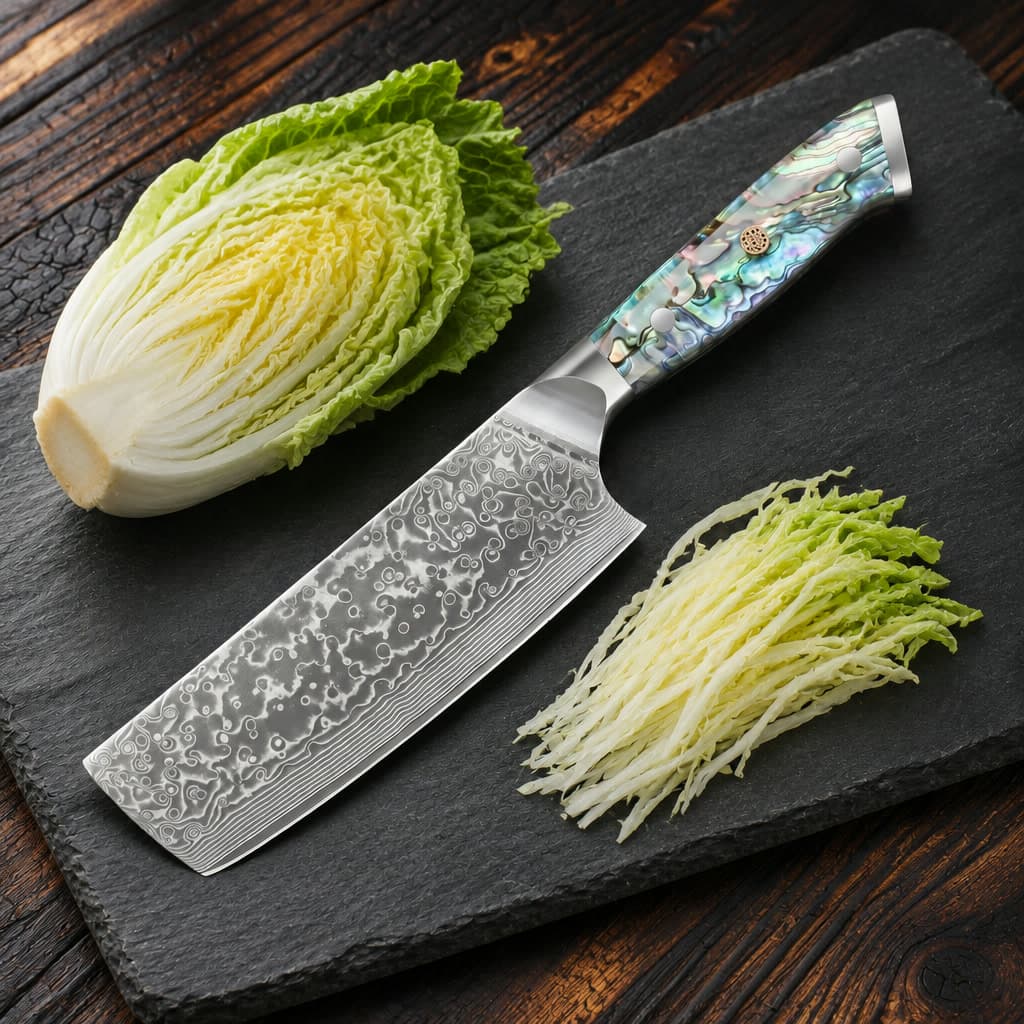
A Nakiri is a Japanese knife made for vegetables, with a tall, rectangular blade and a straight edge built for controlled chopping, slicing, and dicing. Because the edge meets the board along its full length and is sharpened on both sides, it suits cooks who prep vegetables often and favor straight or push cuts.
What exactly is a nakiri knife?
The Nakiri is a Japanese knife built specifically for preparing vegetables. Where an all-purpose Gyuto or Santoku covers everything, its shape is deliberately optimized for vegetable work on the board.
WHAT THE WORD “NAKIRI” MEANS
The name Nakiri (菜切り) translates to vegetable cutting. It is not a general-purpose chef knife but a specialist tool for chopping, slicing, dicing, and prepping vegetables.
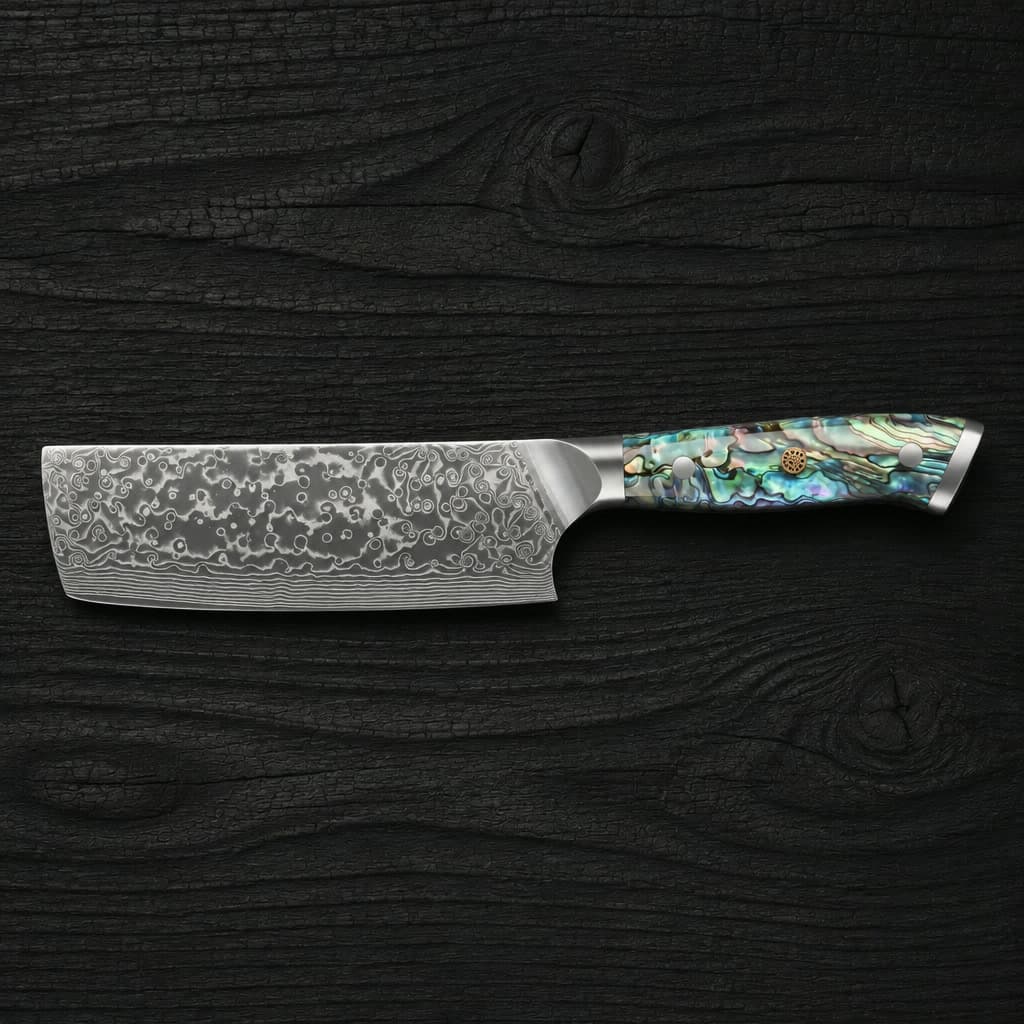
Its specialization comes down to geometry. Most Nakiri knives pair a tall, rectangular blade with a flat or almost flat edge, and finish in a squared or softly rounded front instead of a sharp pointed tip. Most modern versions are also double-bevel, so right- and left-handed cooks can use them equally well.
The blade tends to be thin and fairly tall. That thin geometry lets the edge glide cleanly through vegetables, and the extra height gives your knuckles room to clear the board. The wide face also makes it simpler to carry chopped vegetables off the cutting board.
THE SHAPE BEHIND THE NAKIRI
What sets it apart is how the flat edge meets the cutting board. During a controlled downward or forward cut, much of the edge can touch the board at once. That is why the Nakiri feels especially natural to cooks who favor precise chopping over a pronounced rocking motion.
Most Nakiri blades sit somewhere in the 150–180mm range, and 165mm is an especially popular size for home kitchens.
What is a nakiri knife best for?
A Nakiri proves its worth when vegetables make up a large share of your cooking. The flat edge and tall blade are well matched to repetitive board work where even, consistent cuts count.
VEGETABLES WHERE A NAKIRI REALLY SHINES
A Nakiri is especially good with onions, cabbage, napa cabbage, carrots, daikon, radishes, cucumbers, leafy greens, scallions, eggplant, herbs, and other everyday produce.
Its shape lends itself to several everyday prep tasks:
- Slicing: clean, controlled cuts through produce like cucumbers, carrots, and daikon.
- Dicing: accurate downward cuts through onions and other firm vegetables.
- Julienne: repeated straight strokes for even vegetable strips.
- Chopping: quick work of cabbage, leafy greens, herbs, and similar ingredients.
- Mincing: steady, repeated cuts when you prep herbs and finely chopped vegetables.
- Shredding: especially handy with cabbage and leafy greens.
The tall blade is also a real asset when you work with bigger vegetables. The extra height keeps your knuckles clear and gives you a wide surface for carrying prepped ingredients.
NAKIRI USE CASES BY VEGETABLE
PRODUCE OR TASK
NAKIRI RATING
REASON
Onions
Excellent
The flat edge allows controlled dicing
Cabbage
Excellent
Tall, broad blade suits repeated chopping
Carrots
Excellent
Straight strokes give even slices
Daikon
Excellent
The flat edge allows accurate slicing
Cucumber
Excellent
Good for even, controlled cuts
Leafy greens
Excellent
Makes quick work of repeated chopping
Herbs
Very good
Compact blade allows steady mincing
Large squash
It depends
Dense produce puts more strain on a thin edge
Boneless meat
Limited
Its shape is optimized for vegetables, not for preparing protein
Bones or frozen food
Unsuitable
Impacts can harm a fine edge
Although it looks rectangular, a Nakiri is not a small cleaver. It was never meant for bones, frozen food, hard impacts, or prying. What it does best is controlled vegetable prep, not heavy chopping.
Nakiri vs. santoku vs. usuba: which japanese vegetable knife suits you?
Nakiri, Santoku, and Usuba all come up when people talk about Japanese vegetable prep, yet each one has a different job.
NAKIRI VS. SANTOKU
Of the two, the Nakiri is the more specialized vegetable knife. A flatter edge and taller rectangular blade favor straight chopping and push cuts, with the edge meeting the board along much of its length.
The Santoku, on the other hand, is built as a compact all-purpose knife. Its profile copes with vegetables as well as boneless meat and fish, which makes it a sensible pick when one knife has to cover a broader range of ingredients.
Pick a Nakiri if vegetables are central to your cooking and you want a purpose-built shape. Pick a Santoku if versatility counts for more than specialization.
NAKIRI VS. USUBA
The Nakiri and Usuba are closer cousins, since both are tied to vegetable prep. Even so, they are built differently and meant for different uses.
Most Nakiri knives are double-beveled, which makes them relatively easy for everyday cooks to use and look after. A traditional Usuba is single-beveled and linked to more specialized Japanese vegetable techniques.
Usuba knives are best known for techniques like katsuramuki, in which a vegetable is cut into one very thin, continuous sheet. Their single-bevel geometry calls for a different way of handling and sharpening.
So an Usuba is not just a “better Nakiri.” It is a separate tool, made for a different level and style of vegetable work.
AT A GLANCE
FEATURE
NAKIRI
SANTOKU
USUBA
Main job
Specialist for vegetables
General purpose
Pro-level vegetable work
Edge
Flat / almost flat
Gently curved
Flat
Bevel
Double
Double
Single
Tip
Square / rounded
Blunt front you can use
Classic square profile
Ideal motion
Push / chop
Push / chop plus draw cuts
Classic vegetable techniques
Best suited to
Produce-focused cooks
Everyday home cooks
Seasoned Japanese knife users
If you are weighing Japanese knife shapes more widely, a dedicated guide to Gyuto vs. Santoku can show where the Nakiri fits among other everyday choices.
Choosing japanese knives: the nakiri
Picking a Nakiri is not about chasing one “best” specification; it is about matching the knife's size and build to the way you really cook.
PICK THE RIGHT BLADE LENGTH
Most Nakiri knives tend to come in at 165–180mm.
For many home kitchens, a 165mm Nakiri is a sensible place to start. It strikes a good balance between cutting area and maneuverability and doesn't call for an especially large cutting board.
A 180mm blade gives you extra reach, which comes in handy with bigger vegetables or when you work through larger batches of produce.
You should also factor in:
- The size of your hand
- The size of your cutting board
- How big your vegetables usually are
- How much food you prep in one go
- How much counter space you have
- Your own cutting style
On a compact board, a shorter blade can feel easier to control; with big vegetables and larger batches, a longer blade can speed things up. No single Nakiri length is right for everyone.
MAKE SENSE OF STEEL AND HARDNESS
The steel influences upkeep, sharpening behavior, resistance to corrosion, and the qualities of the edge.
For daily kitchen use, stainless steel is usually the easy option, since it needs less vigilance about moisture and corrosion. That is especially handy if you often cut wet or acidic vegetables.
Carbon steel can sharpen beautifully, but it takes more care to keep corrosion and stains at bay.
VG-10 is a widely used stainless knife steel that appears in many Japanese kitchen knives. Still, the name of the steel alone won't tell you how a knife will perform.
HRC is simply a hardness measurement, and a higher number doesn't automatically make a better knife. Heat treatment, blade geometry, edge thickness, toughness, and intended use all shape how a knife behaves on the cutting board.
To go deeper into these factors, read the Japanese knife steel guide.
CHECK THE GRIND, THICKNESS, AND EDGE GEOMETRY
On a Nakiri, the geometry behind the edge can matter as much as the name of the steel.
A thin edge meets less resistance in vegetables and gives a precise feel as it cuts. The flip side is that thinner geometry calls for proper technique: twisting, prying, or hitting hard materials can damage a fine edge whatever steel it is made from.
Blade thickness and edge angle are separate specifications, too. A thicker blade isn't necessarily dull, and a thin one isn't automatically more durable. Look at how grind, thickness, edge geometry, and heat treatment combine.
THINK ABOUT HANDLE, HEIGHT, WEIGHT, AND BALANCE
The more repetitive your vegetable prep becomes, the more ergonomics start to matter.
Japanese wa-style handles and Western-style handles differ in shape and in how they feel in the hand. Neither wins outright; your grip preference and hand size are what count.
Blade height is another practical point. A taller Nakiri leaves more room for the guiding hand and gives you a wide blade face for carrying chopped vegetables.
Weight and balance are just as personal. Some cooks like a lighter, nimble knife for repetitive prep, while others welcome extra heft for dense vegetables. The right balance is whichever one stays controlled and comfortable for an entire prep session.
How to use a nakiri knife the right way
A Nakiri's flat edge performs best when you use the cutting motions its shape was built for.
STICK TO STRAIGHT CHOPS AND PUSH CUTS
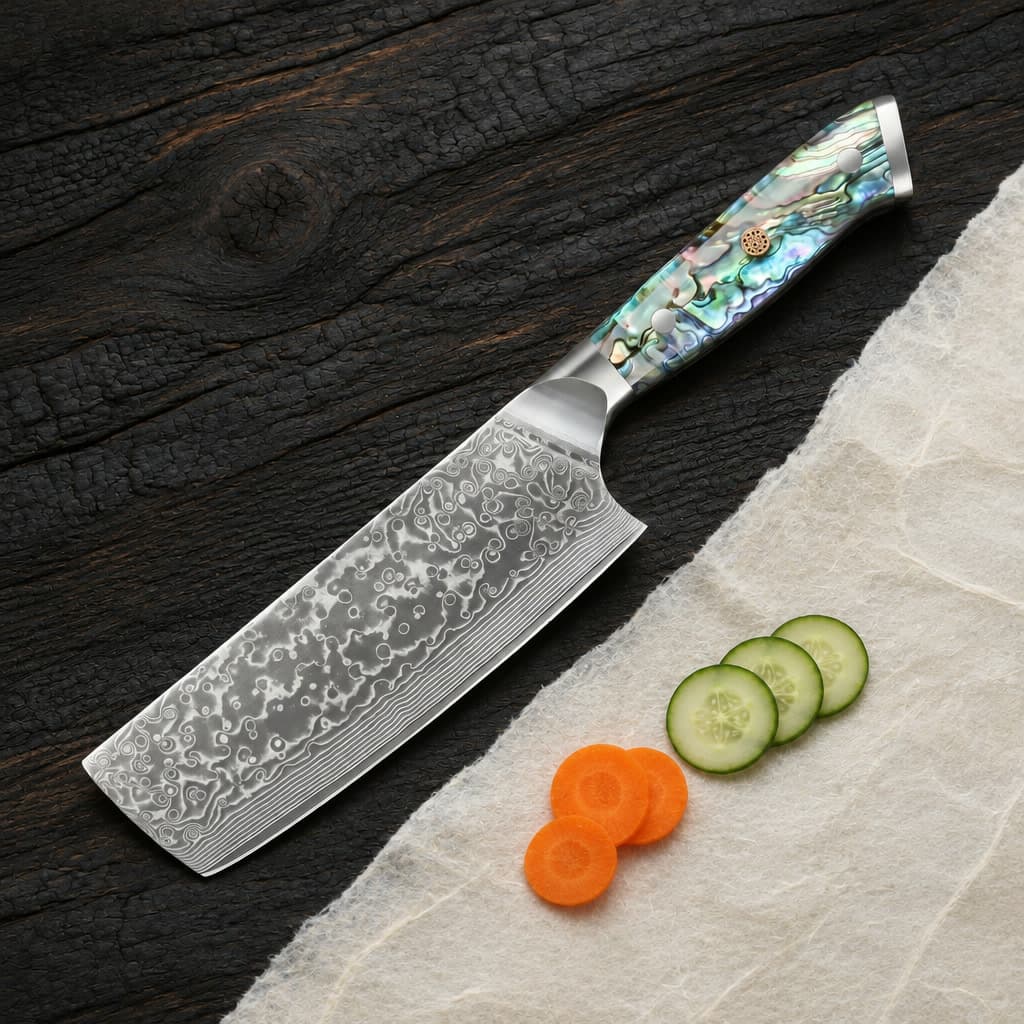
Begin with a firm pinch grip and curl your guiding hand into a protective claw. To chop, lower the blade in a controlled, vertical stroke.
To slice, push gently forward and down so the edge travels through the vegetable while staying in contact with the board.
With its flat or almost flat edge, a Nakiri can bring much of its cutting edge down onto the board. That is a different approach from leaning on a pronounced rocking motion.
This pays off especially in repetitive vegetable prep when even slices, strips, or dice are what you're after.
MAKE THE MOST OF THE TALL BLADE
Its tall profile leaves welcome knuckle room between the cutting board and the hand that guides the vegetable.
The wide blade also helps carry chopped ingredients from the board to a bowl, pan, or container. Use the flat of the knife for this instead of scraping hard with the edge, which wears the edge down for no good reason.
WHAT TO KEEP AWAY FROM IT
Never use a Nakiri on bones or frozen food. Don't twist, pry, or put sideways pressure on the edge.
Dense vegetables like large squash call for extra care. If a cut takes real force, rethink your cutting position and technique instead of muscling the blade through.
Its rectangular shape may look like a small cleaver, but a Nakiri's fine edge is meant for controlled vegetable work—not for impact cuts.
Caring for and sharpening a nakiri knife
The fine vegetable edge of a Nakiri rewards simple, regular upkeep.
EVERYDAY NAKIRI CARE
Wash the knife by hand after each use and dry it right away. Don't leave it sitting in water or put it in the dishwasher.
Cut on a suitable cutting board, such as wood or a softer synthetic that is right for the job. Steer clear of very hard surfaces like glass or stone, which can speed up edge damage.
Store it safely so that its edge never touches other utensils.
HOW TO SHARPEN A NAKIRI
Sharpening brings back the edge geometry that wears away with use. For many Japanese kitchen knives, a whetstone is a suitable way to sharpen.
Because the Nakiri's edge is fairly straight, holding steady contact with a sharpening stone can be easier than with a strongly curved blade.
No sharpening schedule fits everyone. How often you sharpen depends on how much the knife is used, the cutting board, your technique, the volume of food you prep, and the state of the edge.
For fuller maintenance instructions, see a Japanese knife care guide or Japanese knife sharpening guide.
Who is a nakiri knife for?
A Nakiri is worth it when its specialized shape fits the way you cook.
A NAKIRI IS A GOOD FIT IF YOU:
- Prep vegetables often.
- Cook meals built around vegetables or plants.
- Like straight chopping or push cuts.
- Want even, repeatable vegetable cuts.
- Appreciate a tall blade and a wide cutting surface.
- Have a Gyuto or Santoku already and want a knife just for vegetables.
LOOK AT ANOTHER KNIFE IF YOU:
- Want a single knife for meat, fish, and vegetables.
- Often cut around bones or joints.
- Like a pronounced rocking motion.
- Need a pointed tip for trimming and fine work.
- Seldom prep vegetables.
The easiest way to decide:
Pick a Nakiri for vegetable specialization; pick a Santoku or Gyuto when versatility comes first.
A Nakiri doesn't need to replace your other chef knife. For many cooks, its value lies in adding something the knife they already own can't do as efficiently.
What sets a Hoshigane nakiri apart?
The HOSHIGANE Nakiri is built on the same core idea behind the shape itself: controlled vegetable prep through a straight cutting profile and purpose-built blade geometry.
GEOMETRY DESIGNED FOR VEGETABLE PREP
The 6-inch Nakiri gives you a compact format for vegetable work on the board. Its straight profile suits the controlled chopping and slicing motions the Nakiri shape is known for.
Its tall blade also leaves useful room for the guiding hand and offers a wide surface for carrying prepped vegetables off the cutting board.
HOSHIGANE doesn't treat the Nakiri as a scaled-down cleaver; it places the shape in its Japanese knife range as a dedicated vegetable knife.
STEEL, BUILD, AND FINISH
The current HOSHIGANE Nakiri is built with:
- A VG-10 steel core
- Damascus cladding in 67 layers
- Hardness of 60 ±2 HRC
- Edge geometry of approximately 15° per side
- Japanese blade design
The VG-10 core is the steel that does the cutting, and the Damascus layers form the visible cladding that surrounds it. The 60 ±2 HRC figure states how hard the blade steel is, and the approximately 15° per-side geometry states the intended edge angle.
Read these specifications as pieces of the knife's overall build, not as standalone measures of performance. Steel, heat treatment, grind, thickness, edge geometry, balance, and handling all shape how a Nakiri feels during real vegetable prep.
Browse the HOSHIGANE Nakiri collection to compare the dedicated vegetable knives on offer.
Building a japanese knife set around the nakiri
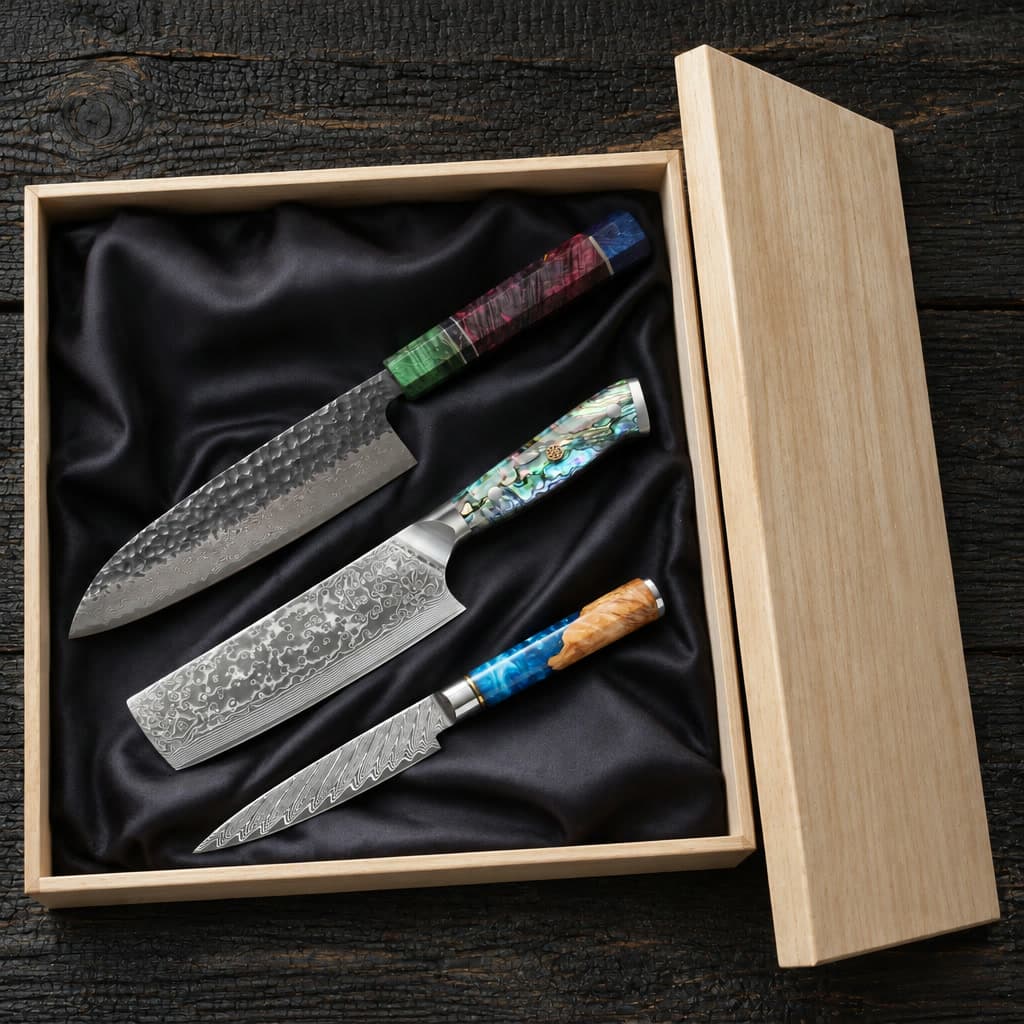
In a deliberately small Japanese knife collection, a Nakiri can play the role of vegetable specialist.
- Nakiri: purpose-built vegetable prep
- Gyuto: wide-ranging all-purpose prep
- Santoku: compact, everyday versatility
- Petty: small tasks and detail work
The aim isn't to gather blade shapes that overlap. It is to pick knives that each do a different job well.
For the bigger picture, begin with a complete Japanese chef knives guide, then add the Nakiri as your specialist once vegetable prep deserves a blade of its own.
Common questions
WHAT IS A NAKIRI KNIFE FOR?
A Nakiri is mainly for vegetables. With its flat edge and tall rectangular blade, it handles chopping, slicing, dicing, julienning, mincing, and other vegetable prep on the board.
IS A NAKIRI A BETTER CHOICE THAN A SANTOKU?
Neither one wins outright. Thanks to its flat edge, a Nakiri is more specialized for vegetable prep, whereas a Santoku is more versatile across vegetables, boneless meat, and fish.
CAN A NAKIRI KNIFE CUT MEAT?
Technically, a Nakiri can slice some boneless meat, but it isn't built for general meat prep, trimming around bones, or heavy cutting. If you cook protein regularly, a Santoku or Gyuto is usually the better fit.
WHICH SIZE NAKIRI KNIFE SHOULD I CHOOSE?
Most sit within a range of roughly 165–180mm. A 165mm Nakiri suits many home kitchens well, while 180mm adds reach for bigger vegetables, larger boards, or bigger batches of prep.
HOW IS A NAKIRI DIFFERENT FROM AN USUBA?
Most Nakiri knives are double-beveled and made for approachable everyday vegetable prep. A traditional Usuba is single-beveled and tied to more specialized Japanese vegetable techniques, katsuramuki among them.