
Knife guides
Storing Japanese Chef Knives the Right Way
September 28, 2026
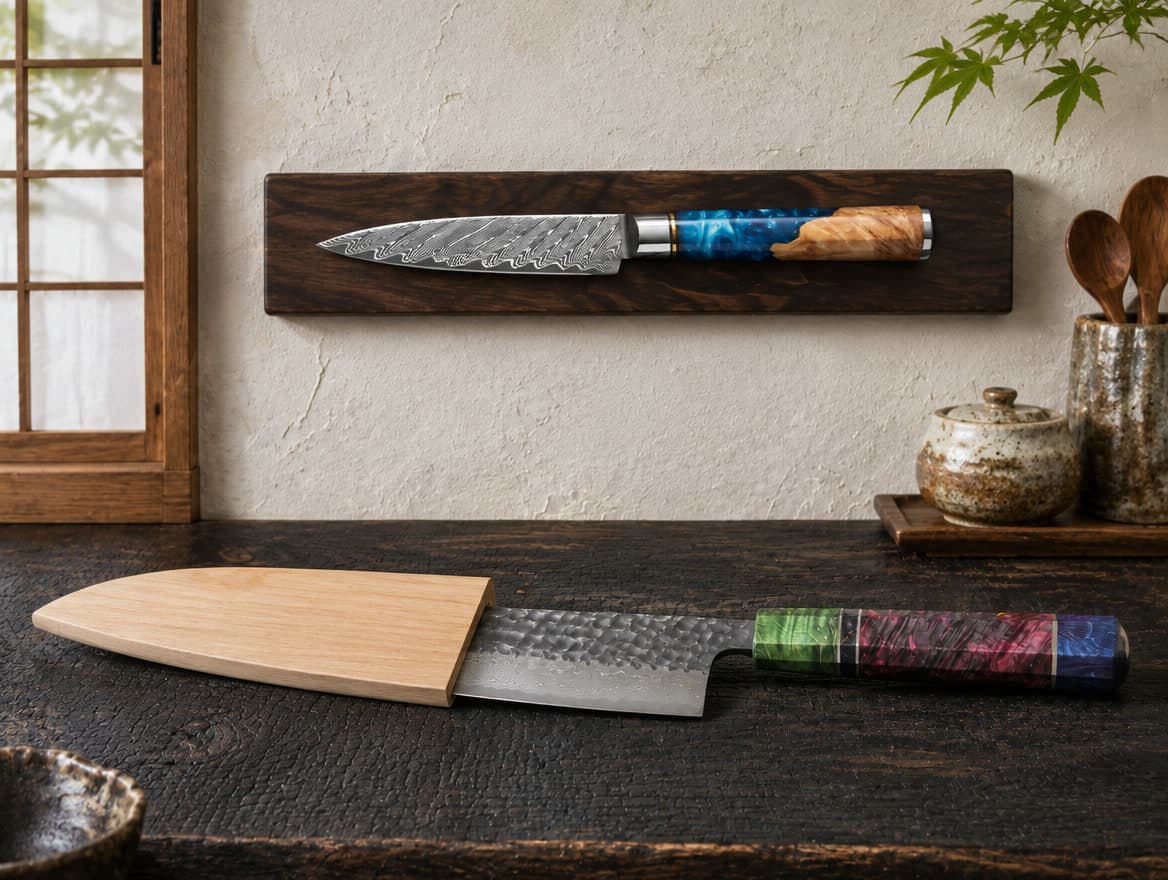
Much of the damage to an edge happens off the cutting board, between meals, when a knife bumps into utensils, hard surfaces or another blade. A HOSHIGANE knife pairs a VG-10 steel core hardened to 60 ±2 HRC with an edge sharpened to 12 to 15 degrees per side. Such a hard, thin edge keeps its sharpness for ages, yet it chips more readily than a softer Western edge when it strikes something hard.
Happily, four simple options all keep the edge protected. Here is how they stack up.
The storage options side by side
OPTION
IDEAL FOR
MIND THE
Knife block
A set kept on the counter, always close at hand
Slots deep enough for your longest blade
In-drawer block
Tight counter space, knives kept out of view
A single knife per slot, handles clearing the drawer
Magnetic strip
Clears the counter, fast to reach
Spine on first, edge off first, fixed up high
Blade guard (saya)
Travelling, a single knife, any drawer
A close fit, and the knife goes in dry only
Never toss it loose in a drawer. A loose knife can bang into utensils and other blades each time the drawer opens, chipping a hard, thin edge and endangering your fingers as you reach in.
Knife block
A countertop block gives every blade a slot of its own, so edges never meet and each knife is close at hand while you cook. It is a good fit for anyone who owns a set of three knives or more.
- Pros: holds a full set in one place, quick to use, no mounting needed.
- Cons: uses up counter space, and the inside of the slots is tricky to clean.
- Watch for: how long and wide the slots are. A 9 inch Gyuto calls for a deeper slot than a Petty knife, and a tip jammed against the bottom of a short slot can bend or chip. Guide the knife in along its spine so the edge never scrapes the wood, and only store it once it is completely dry.
In-drawer block
An in-drawer block is a shallow tray with slanted slots that fits inside a kitchen drawer. Your knives stay hidden and the counter stays clear. On its own it will not keep children away: that takes a child-safety lock on the drawer.
- Pros: out of sight, frees the counter, nothing to drill.
- Cons: takes up a whole drawer, and only fits a set number of knives.
- Watch for: a single knife per slot, each blade pushed all the way in, and enough room for the handles to clear the drawer above. A flat cutlery organizer does not count: if the blades can touch or shift, it is still a loose drawer.
Magnetic strip
Mounted on the wall, a magnetic strip clears the counter and keeps every blade separate and visible. It is what you see in the photo above.
- Pros: space-saving, easy to grab, blades never touch one another.
- Cons: anyone tall enough can reach the knives, and a careless grab can chip an edge.
- Watch for: the way the blade meets the magnet. Set the spine against the strip first, then roll the blade down flat. To remove it, leave the spine on the strip, roll the edge off first, then lift the knife away. Never drag the knife along the strip, and never let the cutting edge touch it.
Blade guard or saya
A blade guard slides over the edge. A saya is a wooden sheath in the Japanese style, usually secured with a small pin. With either one, a knife can travel in a drawer, a bag or a knife roll without its edge touching a thing.
- Pros: inexpensive, portable, protects a single knife anywhere.
- Cons: you need one guard per knife, and it is an extra step each time.
- Watch for: fit and dampness. The guard has to suit the blade's length and shape: a Nakiri takes a different guard than a Gyuto, and a loose guard lets the blade rattle around. Only put away a clean, completely dry knife, since moisture trapped inside can spot the steel.
Which option is right for you?
- One or two knives in a small kitchen: a blade guard on each, or a compact in-drawer block.
- A complete set and lots of counter space: a knife block that fits your longest blade.
- Tight on counter space: a magnetic strip, fixed up high.
- Kids at home: an in-drawer block inside a drawer fitted with a child-safety lock.
- Cooking on the road: a blade guard on each knife you bring.
What not to do
- Tossed loose in a utensil drawer, or piled on top of other knives.
- Left sitting in the sink, the draining rack or the dishwasher basket.
- Stored while still wet, or rolled up in a damp towel or cloth.
- A guard or slot so snug that the blade has to be forced in.
Putting it away every time
Storage can only protect the edge once the knife is actually in it. When you finish cooking, hand wash the blade, dry it thoroughly and return it straight away to its slot, its strip or its guard, instead of leaving it on the counter for later. Our guide on how to care for a Japanese knife sets out the whole one-minute routine.
An edge that is stored well goes to the whetstone less often. When the time comes, our guide on how to sharpen a Japanese chef knife takes you through each step.
SHOP THE GUIDE
CHEF KNIVES (GYUTO)
Free shipping across Canada · Returns within 30 days