
Knife guides
Caring for Your Japanese Knife
September 28, 2026
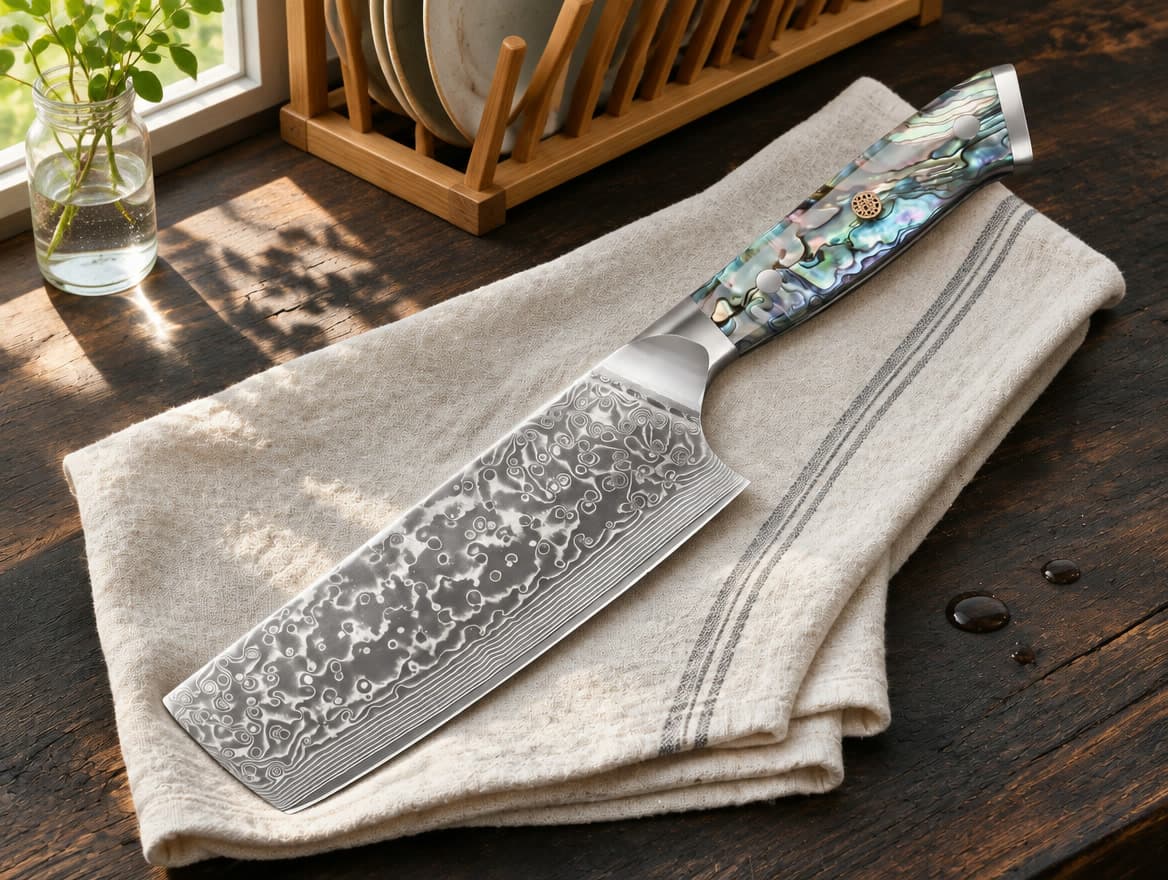
Every HOSHIGANE chef knife has a VG-10 steel core hardened to 60 ±2 HRC, clad in 67 layers of Damascus and sharpened to an edge of 12 to 15 degrees per side. It is this hard, thin edge that slips through a tomato skin. It also calls for a few habits that differ from those of a softer Western knife, and the full routine takes roughly a minute.
Your everyday routine
- Wipe while you cook. Clean food off the blade with a damp cloth as you work, so nothing dries on the steel. After raw meat, poultry or seafood, wash the knife in warm water with a mild soap before it goes near other ingredients, and wash the board as well.
- Hand wash as soon as you finish cooking. Use warm water, a drop of mild dish soap and a soft sponge. No dishwasher, ever, and never leave the knife to soak in the sink.
- Dry it fully, right away. Towel off both sides of the blade, the spine and the handle. Never leave it to air dry on a rack.
- Store it with the edge covered. Use a block, a magnetic strip, a drawer insert or a blade guard, never loose in a drawer.
Tip: Dry from the spine, with the edge facing away from your fingers. Never grip the edge in the towel and draw it through.
Dos and don'ts in brief
- Do wash by hand in warm water with mild soap, then dry right away.
- Do use a wood or plastic board.
- Do store the knife where its edge never meets metal.
- Don't put it in the dishwasher or let it soak.
- Don't use glass, stone, marble or ceramic as a cutting surface.
- Don't reach for a honing steel, twist the blade to pry food apart, or cut through bone or frozen food.
Pick the right cutting board
The board beneath the blade counts nearly as much as the knife itself. Go for wood or food-grade plastic: both yield a little under the edge, which keeps it keen. Steer clear of glass, stone, marble and ceramic. Such hard surfaces can blunt or chip a fine edge in just one session. Use a glass or marble board for serving, and do your cutting on wood or plastic.
Let the blade cut, don't fight it
A thin, hard edge is designed for clean slicing, not brute force. Use a smooth pushing or pulling stroke and let the blade do the work. To shift chopped food across the board, turn the knife over and use the spine, since scraping sideways with the edge will bend it. Leave bones, frozen food and prying to a heavier tool.
Leave out the honing steel
A ridged honing steel is designed for softer Western edges. On a hard edge such as VG-10 at 60 ±2 HRC, it can chip the edge instead of straightening it, so we advise against one. To freshen the edge between sharpenings, use a fine ceramic rod or a leather strop: a few light strokes per side at the same angle as the edge, with hardly any pressure.
Once the knife stops cutting cleanly even after a light strop, it is time for the whetstone. How often depends on how much you cook and what surface you cut on. Our guide on how to sharpen a Japanese chef knife takes you through it step by step.
Spots, rust and acidic ingredients
VG-10 is a stainless steel, so it stands up to rust much better than carbon steel and does not develop a patina. Still, stainless does not mean rustproof. Water, salt or acid left on the blade can cause small spots over time. Rinse and dry the knife shortly after cutting citrus, tomatoes, pickles or anything in vinegar or brine.
If a spot shows up, deal with it early using a soft cloth and a little dish soap, then rinse and dry. Stay away from steel wool and scouring powder, which scratch the Damascus finish.
Take care of the handle
Dry the handle with the same care as the blade, and never leave it standing in water. Resin and G10 handles need nothing else. If a wooden handle begins to look dull or faded, give it a thin coat of food-safe mineral oil; wipe away the excess and let it dry before you use it.
Store it to keep the edge sharp
Where the knife sits between meals makes a big difference. A knife block, a magnetic strip, an in-drawer tray with individual slots or a blade guard all keep the edge away from metal and other utensils. Our guide on how to store Japanese chef knives weighs up each option.
SHOP THE GUIDE
KNIFE SETS
Free shipping across Canada · returns within 30 days