
Knife guides
Damascus Steel Knife Sets: The Full Buyer's Guide
October 16, 2026
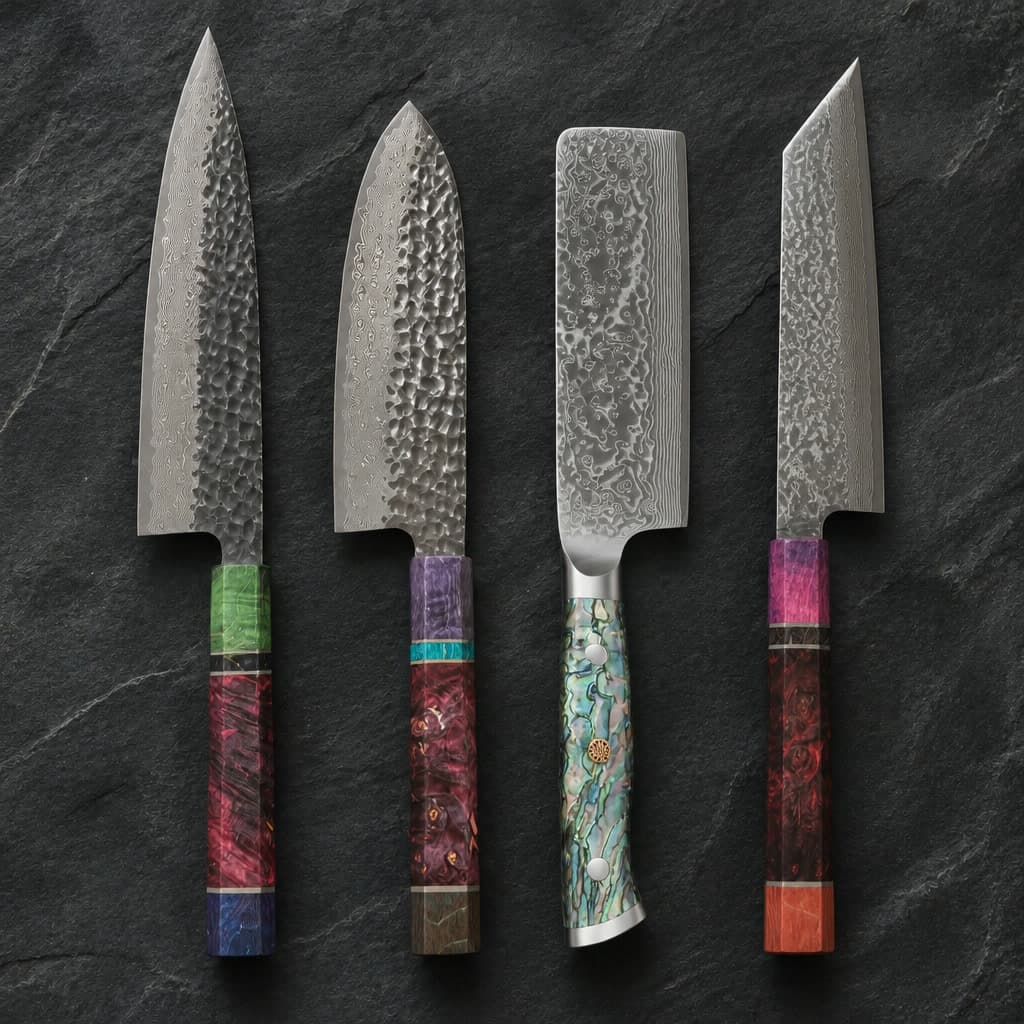
A good Damascus steel knife set brings together versatile blade shapes, a clearly named core steel, comfortable handles, and layered construction built for daily kitchen use. For most home cooks, a well-chosen 3- to 5-piece set delivers more real value than a bigger collection of knives that overlap.
The best set for you depends on what you cook, how often you cook, and which blades will genuinely see use. Knowing how the steel is built, what each knife shape does, and how sets are put together leads to a smarter purchase.
What is a Damascus steel knife set?
A Damascus steel knife set is a group of kitchen knives with distinctive layered steel patterns. Modern Japanese-style Damascus knives often wrap a hard cutting core in many layers of steel, which produces flowing patterns along the blade.
The look is striking, but what lies under the surface, the materials and the build, deserves a closer look.
HOW A DAMASCUS STEEL KNIFE IS MADE
Many modern Damascus kitchen knives place a central cutting core between alternating layers of steel. In production, those layers are bonded, shaped, ground, and finished until the signature pattern appears.
That is not the same as pattern-welded blades, which combine different steels through the whole blade. Some cheap knives also rely on decorative surface finishes that mimic layered patterns without the same construction.
According to HOSHIGANE's published specifications, the knives pair a VG-10 stainless steel cutting core with 67-layer Damascus construction: a clearly defined cutting steel inside a patterned exterior.
DOES DAMASCUS STEEL MAKE A KNIFE CUT BETTER?
Damascus construction alone won't make a knife sharper or longer-lasting.
How well a knife cuts comes down mainly to the core steel, heat treatment, blade geometry, and the quality of the sharpening. A well-hardened blade with a carefully finished edge can beat a pricier Damascus knife with poorer geometry.
Layer count plays a part in the build and the look, but it is not a dependable gauge of cutting ability.
Which knives belong in a Damascus kitchen knife set?
A useful Damascus kitchen knife set holds blades that complement each other, not several knives doing almost the same job. Every knife should have a clear role in daily prep.
THE CORE KNIVES FOR DAILY COOKING
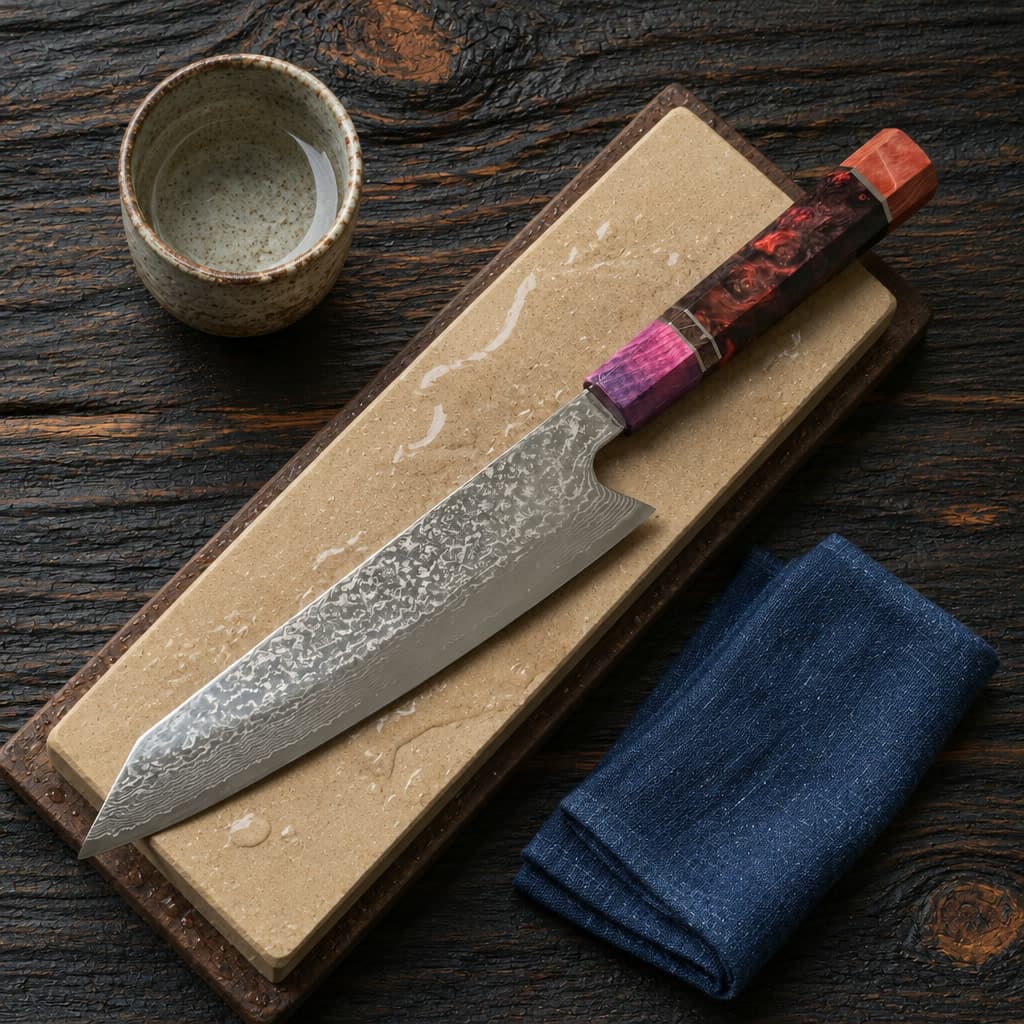
- Gyuto (chef's knife): A versatile Japanese chef knife for chopping vegetables, slicing meat, mincing herbs, and all-round food prep. Its curved edge lends itself to many cutting techniques.
- Santoku: An all-purpose knife widely used for vegetables, meat, and fish. Its fairly flat cutting profile is well suited to controlled chopping and push cuts.
- Petty (utility knife): A shorter blade for trimming ingredients, slicing fruit, and jobs that feel clumsy with a full-size chef's knife.
- Paring knife: A small knife for peeling, coring, and fine work, including jobs done with the ingredient held in your hand.
Either a gyuto or a santoku can be your main kitchen knife. Having both helps some cooks, but it isn't a must for everyone.
For a side-by-side look, read HOSHIGANE's gyuto vs santoku guide.
SPECIALIST BLADES WORTH CONSIDERING
Specialist knives earn their place when your cooking regularly involves jobs an all-purpose blade copes with less comfortably.
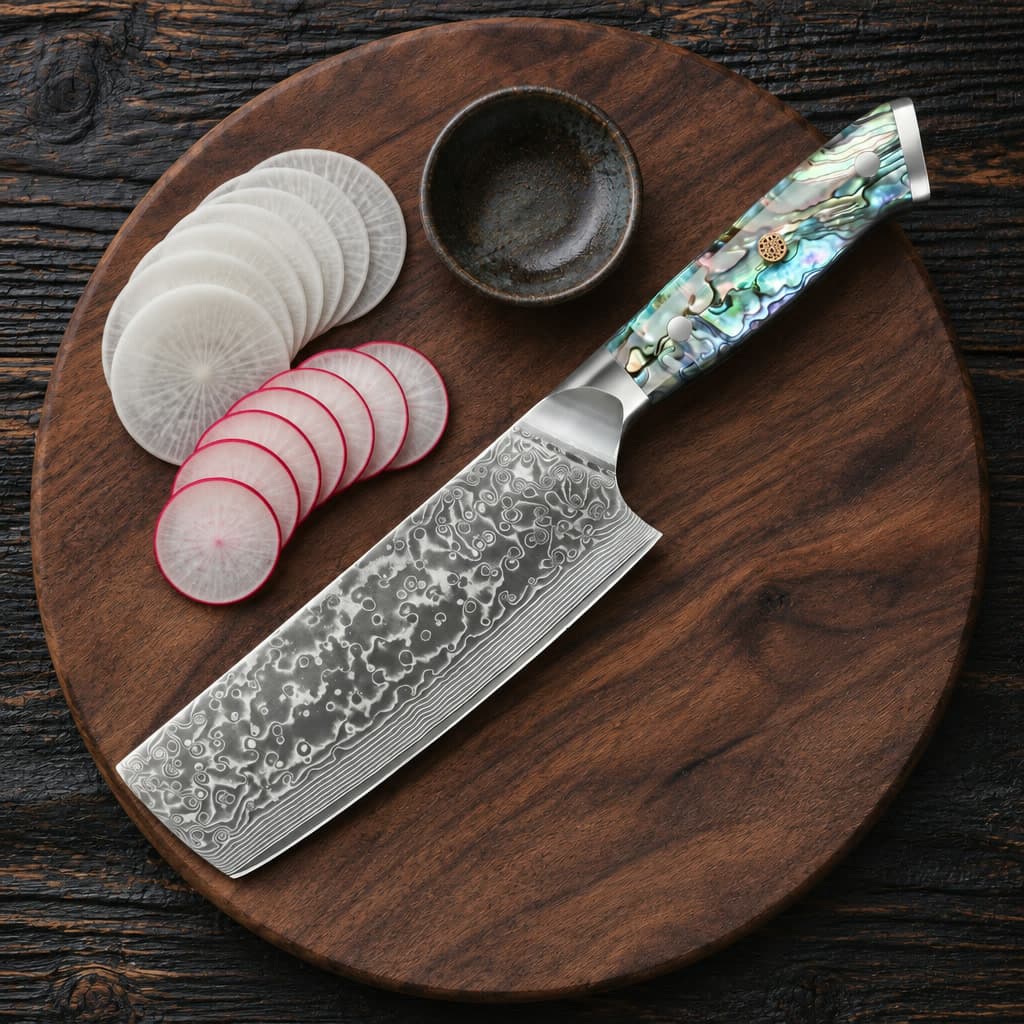
- Nakiri: Its wide, fairly straight edge makes it especially handy for chopping vegetables.
- Kiritsuke: Depending on the design, this knife handles precise slicing and general prep, though traditional single-bevel versions call for specialized technique.
- Bread knife: Its serrated blade gets through crusty bread without crushing it too much.
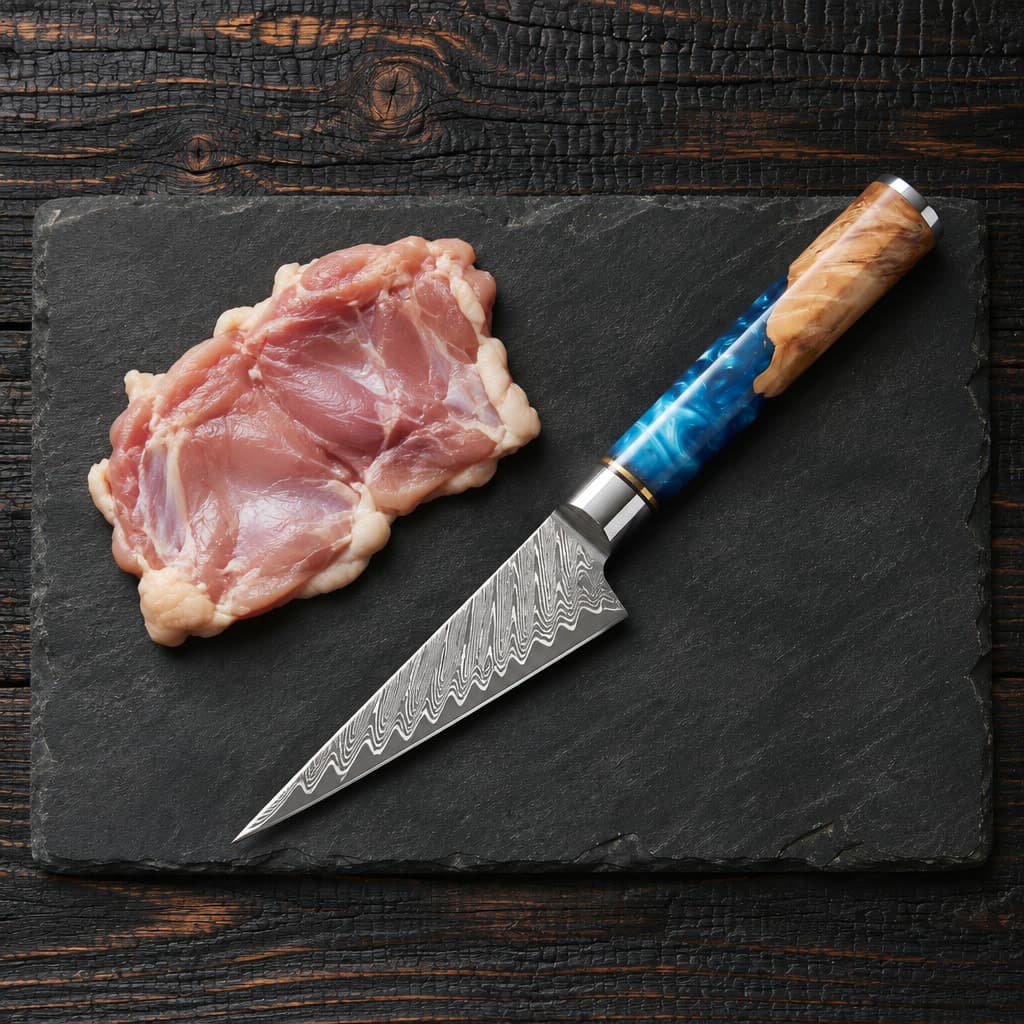
- Boning knife: A slim blade made for trimming meat and working around bones, not for cutting through them.
Choose specialist knives according to how you actually prepare food, not the piece count on the box.
Damascus steel knife sets by size: 2, 3, 5, and 7 pieces
Knife sets run from compact pairs to large collections. A bigger set gives you more blade choices, but extra knives are only worth having if each one does a different job.
WHAT COMES IN EACH DAMASCUS KNIFE SET SIZE?
The table below gives practical sample setups for different cooking needs.
Set size
Sample knives included
Ideal for
2-piece
Gyuto + Petty
Minimalist kitchens
3-piece
Gyuto + Nakiri + Petty
Daily home cooking
5-piece
Gyuto + Santoku + Nakiri + Petty + bread knife
Regular, varied cooking
7-piece
The five-piece lineup + slicing knife + boning knife
Wide-ranging prep needs
These combinations are examples only, not confirmed HOSHIGANE product bundles. What a set contains differs from one maker to another.
A two-piece pairing covers a surprising share of everyday cooking. The gyuto takes care of most board work, and the petty deals with smaller ingredients and fine trimming.
Three-piece sets add a blade devoted to one recurring job, like vegetable prep. Five-piece setups bring more flexibility, especially in kitchens where several people cook or where a wide range of foods is prepared often.
Seven-piece collections are more sensible when the extra blades each have a clear purpose.
WHICH SET SIZE GIVES YOU THE BEST VALUE?
In most home kitchens, two or three well-chosen knives cover the ground very well. A five-piece collection starts to make sense when the extra blades get regular use.
Bigger sets call for a closer look. Some makers include kitchen shears, honing rods, storage blocks, or other accessories in the advertised piece count.
Count the real knives in the set before you compare prices.
Think too about whether the set repeats knives you already have. A smaller set with the right blade shapes can be a wiser buy than a bigger one whose knives barely differ in practice.
How to pick a high-quality Japanese Damascus knife set
Judge a Japanese Damascus knife set on measurable specifications, build details, and how it handles, rather than on looks alone.
CORE STEEL AND LAYERED BUILD
The cutting core sits at the heart of a knife's performance. VG-10 is a stainless cutlery steel widely used in Japanese kitchen knives, and AUS-10 is another choice you'll find in Japanese-style blades.
Each steel reacts in its own way to heat treatment and sharpening. Even two knives made from the same steel can cut differently.
Favour makers who name the core material and describe their layered construction. A visible pattern on its own can't prove what the steel is made of.
For more background on choosing a steel, see HOSHIGANE's Japanese knife steel guide.
ROCKWELL HARDNESS AND HOW LONG AN EDGE LASTS
Rockwell C hardness, written as HRC, gauges how well a material resists indentation in a standardized test.
Harder steels can hold an edge well, but hardness by itself doesn't decide durability. Edge geometry, microstructure, and intended use count too.
HOSHIGANE states a hardness of 60 ±2 HRC for its Damascus knife construction. That figure is a handy benchmark, but it shouldn't be read as a performance rating on its own.
BLADE THICKNESS, EDGE ANGLE, AND HOW A KNIFE CUTS
Blade geometry affects how freely a knife passes through food. Thin blades often meet less resistance, while thicker ones can be sturdier for tough jobs.
The edge angle counts too. HOSHIGANE gives an approximate sharpening angle of 12–15 degrees per side for the knives concerned.
On a symmetrical double-bevel blade, a 15-degree edge on each side adds up to an included angle of about 30 degrees.
For more advice, read how to choose the right knife size.
HANDLE MATERIAL, COMFORT, AND BALANCE
The design of the handle affects control, especially during long prep sessions.
Natural wood gives a traditional feel but can need extra care. Stabilized wood and the right composite materials tend to stand up better to changes caused by moisture.
Think about handle shape, how secure the grip is, and the balance in a pinch grip. Not every Japanese knife design needs a full tang, and comfortable handling counts for more than any single build feature.
CRAFTSMANSHIP AND OPENNESS FROM THE MAKER
Trustworthy makers give clear details about the steel, blade dimensions, construction, and care needs.
Read warranty terms, sharpening support, and claims about where a knife is made with care. Japanese-style geometry or branding does not, on its own, prove that a knife was made in Japan.
For wider buying advice, read how to choose a Japanese chef knife.
Japanese Damascus knife sets vs. standard stainless steel knife sets
Damascus-clad and standard stainless steel knives can both perform superbly in the kitchen. How they differ depends on the materials, geometry, finish, and construction of each product.
Factor
Damascus-clad knife
Standard stainless knife
Appearance
Striking layered pattern
Typically a plain finish
Cutting performance
Comes down to core steel and geometry
Comes down to steel and geometry
Maintenance
Varies with steel and construction
Varies with steel and construction
Price
Often carries a premium for looks or build
Sold at a wide range of prices
A Damascus finish may win over cooks who like to see the craftsmanship. Still, a well-made standard stainless knife can match or beat a Damascus-clad knife for sharpness and edge retention.
Look at the real blade specifications before paying more for looks.
Is a Damascus knife set a better buy than individual knives?
A full set brings convenience and a matching look, while buying knives one by one gives you more say over which blades you get. Which is better depends on the knives you already own and how you prep.
WHY BUY A MATCHING KNIFE SET
A matching set gives you the same handle shapes, materials, and visual style throughout. That can be especially appealing when you are replacing several old knives or choosing a gift.
A set may also cost less than buying each knife in it separately, though it's worth checking this against the individual prices.
For cooks starting out with few tools, a well-curated set takes some of the guesswork out of choosing blades that work together.
WHEN SINGLE JAPANESE KNIVES ARE THE BETTER CHOICE
Buying knives one at a time often makes more sense if you already have a dependable chef's knife or have firm preferences on blade length and handle design.
You can grow your collection step by step, adding a nakiri if you prep a lot of vegetables or a petty for smaller jobs.
This way, you also avoid paying for knives you don't need. HOSHIGANE's Japanese chef knife buying guide gives a wider introduction to choosing single Japanese blades.
How to look after a Damascus steel knife set
Good maintenance protects the edge, keeps the blade's finish looking its best, and cuts down on needless wear. Most Damascus-clad kitchen knives do well with simple daily care.
THE BASICS OF CLEANING, SHARPENING, AND STORAGE
1. Wash by hand after each use. Clean every blade with warm water and a mild soap. Keep knives out of the dishwasher, where they face moisture, heat, and knocks from other utensils.
2. Dry right away. Wipe the blade and handle completely once washed. Even stainless steel knives can stain or corrode when conditions are poor.
3. Use the right cutting boards. Wood and suitable plastic boards are usually gentler on fine edges than glass, stone, or ceramic.
4. Sharpen at the advised angle. A whetstone gives you control as you sharpen. HOSHIGANE advises roughly 1000 grit for sharpening and 3000–6000 grit for finishing, at an angle of about 15 degrees per side where relevant.
5. Keep knives safely stored. Choose protective sheaths, suitable knife blocks, or magnetic storage that keeps the blades from damage.
For step-by-step maintenance, read how to care for a Japanese knife and how to sharpen a Japanese chef knife.
Finding the right Damascus knife set for the way you cook
Every cooking routine asks something different of kitchen knives. Build your collection around the ingredients and techniques you rely on most.
FOR BEGINNERS AND HOME COOKS
Begin with a comfortable gyuto or santoku plus a smaller petty knife. Together they handle daily chopping, slicing, and fine prep without the need for a big collection.
Focus on blade lengths that are easy to manage, secure handles, and simple upkeep. More knives can follow as your cooking habits develop.
FOR CHEFS IN PRO KITCHENS
Pro kitchens call for efficient cutting, comfortable handling, and reliable edge performance through repeated use.
Pick blade shapes to suit your station duties and prep volume. Take into account sharpening needs, handle ergonomics, and the toughness your workplace calls for.
A small, well-judged selection of specialist knives may prove more useful than a large matching set.
FOR VEGETABLE-LED COOKING
A gyuto or santoku deals with most vegetable prep well. Still, cooks who often work through big batches of vegetables may value the straight cutting profile of a nakiri.
A nakiri paired with a petty knife makes a practical duo for chopping, trimming, and smaller prep jobs.
FOR KNIFE COLLECTORS AND GIFT GIVERS
Collectors may care more about documented materials, layered patterns, blade finishing, and traditional design influences.
For a gift, weigh up the recipient's cooking experience, favourite blade shapes, and storage set-up.
A matched collection with clear material specs usually means more than a set picked only for its advertised piece count.
Final checklist: what to verify before you buy
Before settling on a Japanese Damascus knife set, make sure its specifications and mix of blades fit what you really need.
- A clearly named cutting-core steel
- Layered Damascus construction that is documented
- Hardness and edge specs that are published
- Knives that complement each other, no needless overlap
- Comfortable handles and the right blade lengths
- Clear details on care, warranty, and sharpening
- A fair price next to buying the knives singly
A well-chosen set should make daily prep more efficient, with materials and craftsmanship you'll value for years to come.
Damascus steel knife sets: frequently asked questions
ARE DAMASCUS STEEL KNIFE SETS A GOOD BUY?
Yes, a Damascus knife set can be a good buy when it brings together a suitable cutting-core steel, reliable construction, comfortable handling, and useful blade shapes. The layered look adds visual appeal, but real-world cutting performance should stay the main reason to buy.
HOW MANY KNIVES DOES A KITCHEN KNIFE SET REALLY NEED?
Most home cooks can manage day-to-day food preparation with two or three knives that complement one another. A chef's knife or gyuto, a petty or paring knife, and an optional specialist blade see to many everyday jobs. Larger sets earn their keep when the extra knives cover tasks you do often.
IS A 67-LAYER DAMASCUS KNIFE BETTER THAN A 33-LAYER ONE?
Not always. A 67-layer Damascus knife isn't automatically sharper, tougher, or better at holding an edge than a 33-layer knife. How it cuts depends more directly on the core steel's properties, heat treatment, blade geometry, and sharpening quality than on how many decorative layers it has.
HOW DO YOU KNOW IF A DAMASCUS KNIFE SET IS GENUINE?
See whether the maker names the cutting-core steel and describes the layered construction. Genuine layered Damascus patterns come from the structure of the steel itself, whereas decorative finishes can copy the look. The maker's documentation and trustworthy product specifications tell you more than judging a blade by its visible pattern alone.