
Knife guides
A Guide to Japanese Knife Steel
September 28, 2026
Product pages pile on steel jargon: VG-10, HRC, Damascus, high-carbon, stainless. Picking a good knife and keeping it in shape does not take a metallurgy degree. What matters is how each term shows up in three things you will feel at home: how long the edge keeps its bite, how the blade handles water and acid, and how it responds to a whetstone.
In brief: every HOSHIGANE knife has a VG-10 core, a high-carbon stainless steel hardened to 60 ±2 HRC, clad in 67 layers of Damascus. That hard core keeps a thin edge for a long time and fights rust far better than plain carbon steel. The trade-off is that it wants a light touch and a whetstone, not a honing steel.
Vg-10 steel, explained
VG-10 is a high-carbon stainless steel found at the cutting core of many Japanese-style chef knives. Roughly speaking, it holds about 1% carbon and about 15% chromium, along with small amounts of molybdenum, vanadium and cobalt.
- Carbon allows the steel to be hardened, and that hardness is what keeps a thin edge sharp.
- Chromium makes the steel stainless, helping its surface fight off rust and stains.
- Molybdenum, vanadium and cobalt are minor additions that help the steel take a fine, even edge and hold it steady.
What you get is a steel with a foot in each camp: harder and finer at the edge than the usual Western kitchen knife, yet much easier to own than a plain carbon steel blade.
60 ±2 hrc in everyday cooking
HRC stands for the Rockwell C hardness scale. A diamond point is pushed into the steel and the depth of the mark is measured: a shallower mark means harder steel and a higher number. At 60 ±2 HRC, the core sits anywhere from 58 to 62. Hardness is only one piece of the picture, not a rating: composition, heat treatment and edge shape count just as much.
HARDNESS
WHERE YOU SEE IT
WHAT IT FEELS LIKE
Roughly 54 to 58
Most Western-style kitchen knives
Forgiving; the edge rolls more easily and needs more frequent touch-ups
58 to 62
The HOSHIGANE VG-10 core (60 ±2)
Keeps a thin edge well; tolerates twisting and bones less
63 and above
A few very hard specialist steels
Can carry very fine edges; toughness and sharpening effort vary by steel
Day to day, a harder edge stays keen through more meals before it has to go back on the stone. The catch: push a hard, thin edge sideways and it can chip instead of rolling. That usually happens when the blade is twisted inside a squash or knocked against bone. Hence the everyday habits for a Japanese-style knife: cut in smooth strokes, work on a wooden or plastic board, and hand bones and frozen food to a heavier knife.
The job of 67-layer damascus cladding
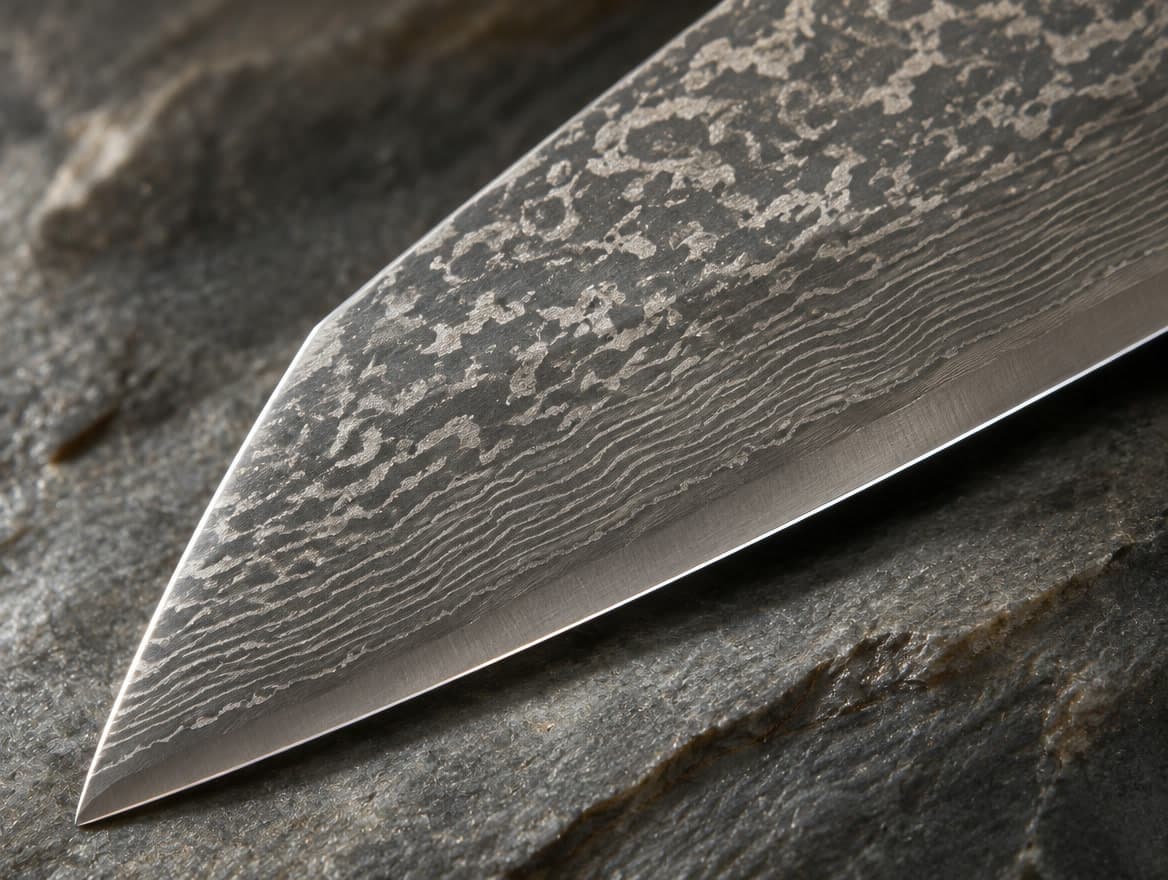
On today's kitchen knives, "Damascus" means layers of steel forged as one and then etched, so the layers appear as a flowing pattern across the blade face. A HOSHIGANE knife wraps its VG-10 core in 67 layers of Damascus cladding. The core runs down the centre of the blade and forms the cutting edge; the cladding makes up the sides.
- What it is for: it builds the outer faces of the blade around the core and gives the visible layered pattern, so no two blades share the same grain.
- What it is not for: the pattern adds no sharpness. How sharp the edge gets and how long it lasts depend on the VG-10 core and how the edge is finished.
Be gentle with the cladding: steel wool and scouring powder will scratch the finish, whereas a soft sponge and mild soap keep the pattern crisp.
Stainless or carbon steel: how the care differs
Many Japanese-style knives are forged from plain carbon steel, which carries little chromium. It can be brought to a very keen edge, but it rusts quickly when left wet and darkens with use as a patina forms. Stainless steels such as VG-10 hold enough chromium to fend off rust and stains far better. VG-10 usually does not build up a patina the way plain carbon steel does, although some discolouration can occur.
STAINLESS (VG-10)
PLAIN CARBON STEEL
Rust
Fends it off well, but is not rustproof
Rusts fast when left wet
Patina
Not usually
Turns darker with use
Oiling
Not required
Usually advised
Stainless is not the same as care-free. Water, salt or acid left sitting on the blade can still leave little spots over time, and the dishwasher is rough on any fine edge. The routine is easy: hand wash in warm water with mild soap, dry right away, and store the knife where its edge never meets metal. Our guide on how to care for a Japanese knife walks you through each step.
How the steel shapes sharpening
Hardness and edge angle are linked. Hard steel can carry a thinner edge without folding over, which is why HOSHIGANE knives get a hand-finished edge of 12 to 15 degrees per side, thinner than most Western kitchen knives. A thin, hard edge like this changes sharpening in three ways.
- Reach for a whetstone. A stone of around 1000 grit sets the edge, and one between 3000 and 6000 polishes it. A hard edge may need a bit longer on the stone than a soft one, so let the stone work instead of bearing down harder.
- Leave out the honing steel and the pull-through sharpener. A ridged honing steel can chip a hard edge, and most pull-through sharpeners are built for a wider Western angle.
- Touch up with a light hand. Between sharpenings, a few gentle passes on a fine ceramic rod or a leather strop, held at the edge's own angle and with barely any pressure, restore the bite.
Our guide on how to sharpen a Japanese chef knife takes you through the angle, the grits and every stroke.
What goes into HOSHIGANE knives
Whatever the blade shape or the handle, every HOSHIGANE knife starts from the same base:
COMPONENT
HOSHIGANE
Core steel
VG-10, a stainless steel high in carbon
Hardness
60 ±2 HRC
Cladding
67 layers of Damascus steel
Edge
Finished by hand, 12 to 15 degrees per side
Since the whole range shares one steel, a single care routine and a single set of stones handle every knife in your block, from a Gyuto to a Nakiri or a Petty. So the decision comes down to blade shape and size, not steel. Explore all HOSHIGANE knives to compare the shapes.
SHOP THE GUIDE
KNIFE SETS
Free delivery across the UK · Returns within 30 days