
Knife guides
Finding the Right Knife Size
September 28, 2026
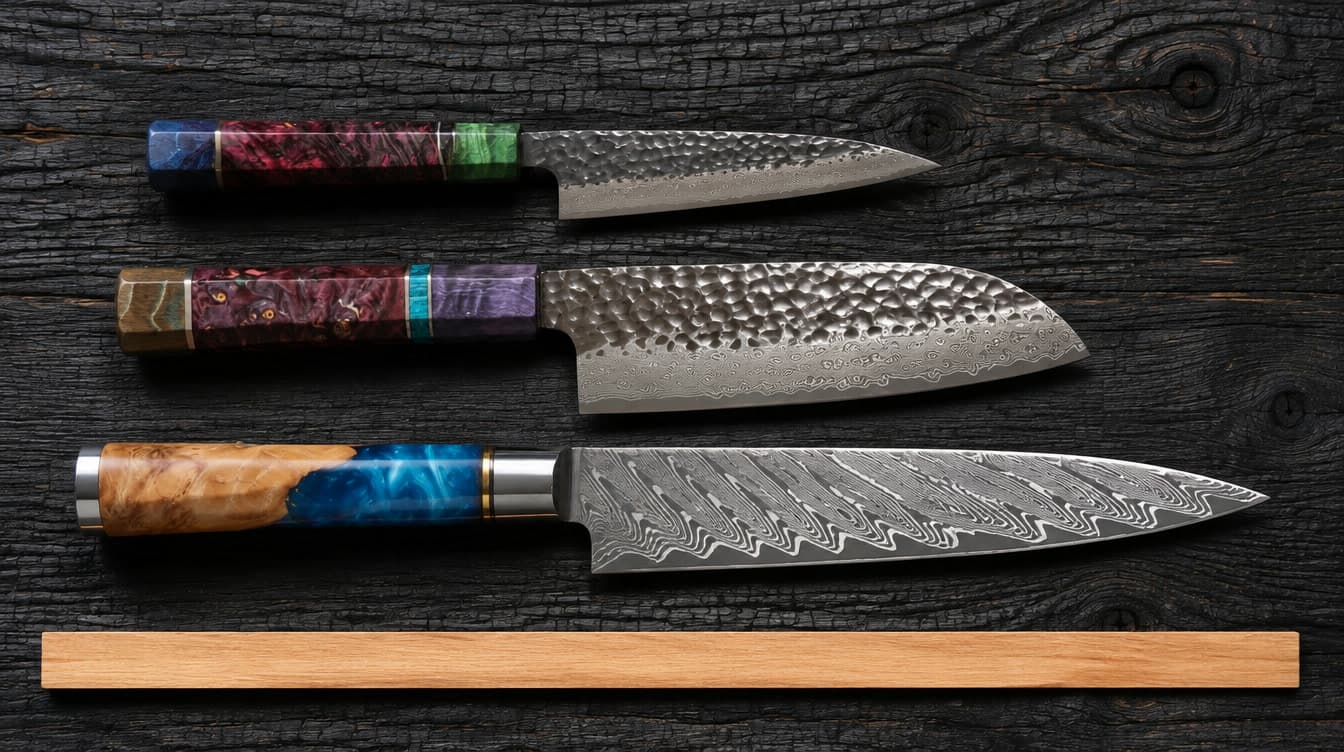
Blade length governs how a knife sits in your hand, how much chopping board it takes up and how many strokes each task needs. Most home cooks start out with an 8 inch (20 cm) Gyuto or a 7 inch (18 cm) Santoku. Below are the lengths we offer in each shape, how to choose between them and what to buy first.
In brief: for a single main knife, an 8 inch (20 cm) Gyuto works for most home cooks. Go for a 7 inch (18 cm) Santoku if you would like a shorter all-rounder for a small board or smaller hands. Add a 5 inch (13 cm) Petty for little jobs, and a Nakiri if vegetables make up most of your prep.
Knife sizes side by side
Lengths refer to the edge only, measured heel to tip, handle excluded.
SHAPE
RANGE
TYPICAL
IDEAL FOR
Gyuto
6-9 in 15-23 cm
8 in 20 cm
All-round prep, meat, large produce
Santoku
5-7.5 in 13-19 cm
7 in 18 cm
Day-to-day chopping
Nakiri
5.5-7.5 in 14-19 cm
7 in 18 cm
Vegetable prep
Kiritsuke
6.5-9 in 16.5-23 cm
8 in 20 cm
Long slices, precise tip work
Petty
4.5-5.5 in 11.5-14 cm
5 in 13 cm
Shallots, small fruit, trimming
Paring
3-4 in 7.5-10 cm
3.5 in 9 cm
In-hand peeling
Why 8 inches (20 cm) works for most home cooks
An 8 inch (20 cm) Gyuto has the length to slice a roast, cut a cabbage in half or rock through a heap of herbs in full strokes, yet stays short enough to handle easily on an ordinary home board. That balance explains why most of the Gyuto knives we sell come in this length. At 8 inches (20 cm), a HOSHIGANE Gyuto weighs about 7 oz (200 g), light enough for a long prep session.
A shorter blade makes more sense when your kitchen, your hands or your cooking lean that way. The four checks below show you which.
Four checks to decide
1. YOUR HAND
How a knife fits comes down to the handle and balance more than to blade length. Look for a handle that fills your grip comfortably, enough blade height to keep your knuckles off the board and a balance point close to where you pinch the blade. Broadly, larger hands usually find an 8 inch (20 cm) Gyuto well proportioned, whereas smaller hands, or cooks new to a very sharp knife, often find a 7 inch (18 cm) Santoku (about 6 oz, 170 g) easier to guide.
2. YOUR COOKING
- Big cuts and large produce: roasts, carving a cooked chicken, squash, cabbage and melons are quicker with an 8 inch (20 cm) Gyuto or Kiritsuke.
- Mainly vegetables: onions, carrots, peppers and greens for weeknight dinners suit a 7 inch (18 cm) Santoku or Nakiri.
- Small tasks: trimming, hulling strawberries and slicing shallots or garlic call for a 5 inch (13 cm) Petty (about 3.5 oz, 100 g).
Whatever length you choose, never cut through bones or frozen food with these knives.
3. THE CHOPPING BOARD YOU USE
A longer blade needs space for a full stroke. As a rough rule, choose a board at least twice the length of the blade: around 16 inches (40 cm) for an 8 inch (20 cm) knife and around 14 inches (36 cm) for a 7 inch (18 cm) one. If your board is smaller and you have no plans to replace it, the shorter knife will feel better day after day.
4. WHERE YOU STORE IT
Measure before buying a long blade. A knife block slot, an in-drawer tray or a magnetic strip has to fit the entire blade, and a 9 inch (23 cm) Gyuto needs a deeper slot than a Petty. Our guide on how to store Japanese chef knives compares every option.
The handling test
A screen won't let you hold a knife, but the one already in your kitchen can take its place.
- Measure the chef knife you own now, from heel to tip.
- Cook a meal with it and notice how it behaves. Does it feel right, too short or too long?
- Adjust by roughly an inch (2.5 cm). If you find yourself sawing back and forth through wide food, size up. If the tip runs past the board or is hard to guide, size down.
Tip: Run the test with a pinch grip: thumb and index finger on the blade just ahead of the handle. Most cooks hold a Japanese chef knife like this, and it makes any length feel more stable.
When to size up or down
Eight inches (20 cm) sits in the middle of the range; it is not a rule. Our Gyuto and Kiritsuke knives reach 9 inches (23 cm), and our shortest Gyuto measures 6 inches (15 cm). A 7 inch (18 cm) Santoku or Nakiri is the other compact choice.
SIZE UP IF
- You regularly cook for a crowd or break down big cuts.
- You have a big board and lots of room on the worktop.
- You already feel comfortable with an 8 inch (20 cm) knife.
SIZE DOWN IF
- Your board, worktop or drawer is rather small.
- You have smaller hands or would like more control.
- You mostly cut vegetables for one or two people.
Where to begin
- One knife: an 8 inch (20 cm) Gyuto, or a 7 inch (18 cm) Santoku if you like a straight chop and a shorter blade. Unsure about the shape? Read Gyuto vs Santoku.
- Two knives: add a 5 inch (13 cm) Petty for the small tasks that feel clumsy with a long blade.
- Plenty of vegetables: a 7 inch (18 cm) Nakiri alongside your Gyuto.
- A flatter edge and an angled tip: an 8 inch (20 cm) Kiritsuke.
Each HOSHIGANE knife is built on the same VG-10 steel core wrapped in 67 layers of Damascus cladding, hardened to 60 ±2 HRC, with a 12 to 15 degree edge on each side. That means you are choosing length and shape, not quality. Many of our knife sets combine a Gyuto with a Petty, or a Gyuto, Nakiri and Petty, so everyday prep and smaller tasks are covered in one matching style.
SHOP THE GUIDE
GYUTO CHEF KNIVES
Free delivery across the UK · 30 days to return