
Knife guides
The Gyuto Chef Knife Guide: Understanding Japan's All-Purpose Blade
3 October 2026
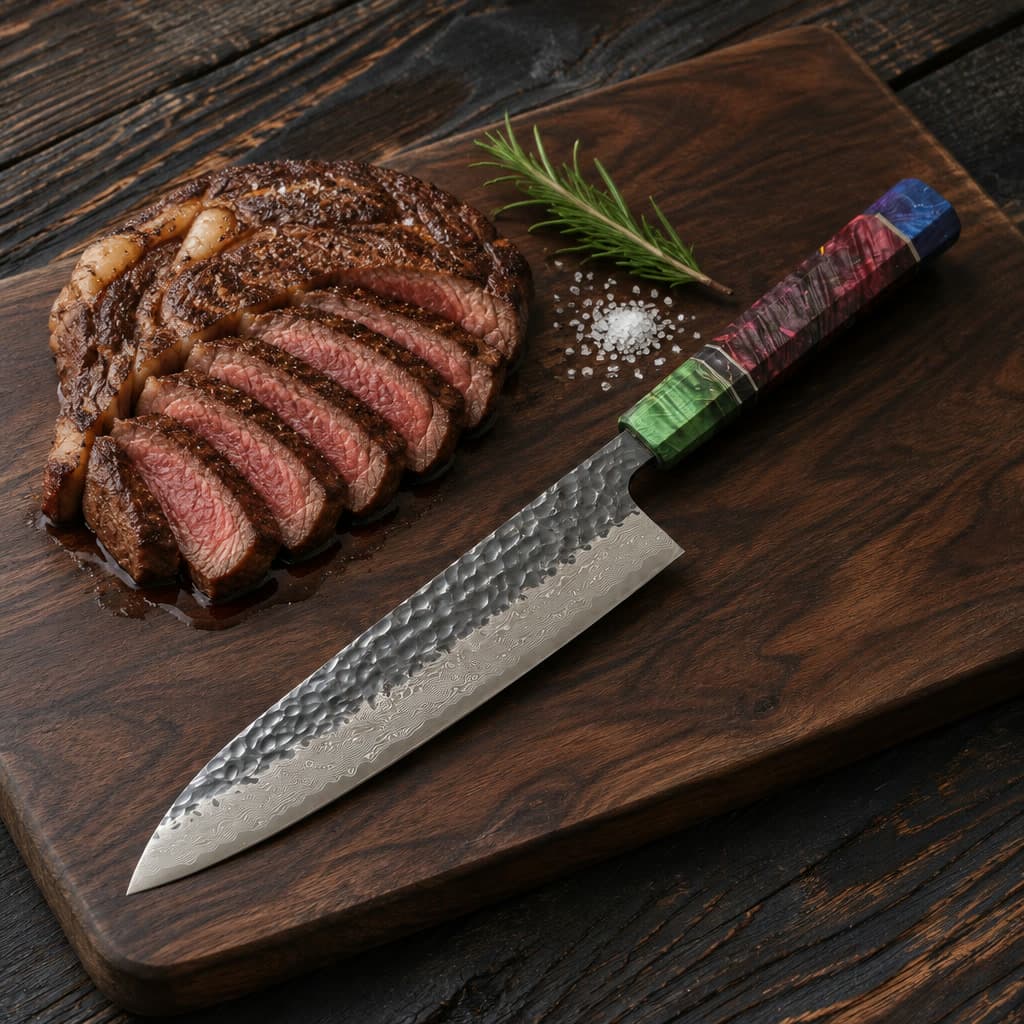
A gyuto chef knife is Japan's all-rounder: a chef's knife built for cutting, slicing, chopping and everyday food prep. Most have a pointed tip, a curved edge and a double-bevel blade, yet the steel, geometry, weight and dimensions can differ widely from one maker or model to the next.
What exactly is a gyuto chef knife?
The Gyuto is the Japanese answer to the all-purpose chef knife. Its name, Gyuto (牛刀), is usually rendered as “beef sword,” a nod to the knife’s historical link with butchering meat, yet today’s Gyuto knives do far more than prepare meat. They take on daily tasks like slicing vegetables, chopping herbs, cutting boneless meat, portioning fish and making exact cuts.
Gyuto is not tied to a single steel or construction method; the word names a broad knife category and blade style. A Gyuto can be forged from stainless, carbon or powder metallurgy steel, and individual knives vary a great deal in thickness, grind, balance, blade height and edge geometry.
THE GYUTO CHEF KNIFE IN BRIEF
FEATURE
WHAT A GYUTO USUALLY OFFERS
Purpose
Everyday all-round kitchen prep
Blade style
Curved cutting edge rising to a pointed tip
Edge
Double-bevel in most cases
Common sizes
180 mm, 210 mm, 240 mm, 270 mm
Typical uses
Vegetables, herbs, boneless meat, fish, slicing
Construction
Depends on the steel, maker and model
Pairing versatility with a fairly precise cutting profile is why the Gyuto works so well as a main kitchen knife. Still, no two Gyuto feel or cut exactly alike. Blade length, steel, grind, edge angle, weight and handle design all shape how a given knife behaves on the chopping board.
What is a gyuto knife good for?
A Gyuto knife handles daily kitchen prep: slicing vegetables, chopping herbs, cutting boneless meat, preparing fish and making precise cuts. With its pointed tip and curved edge, it is versatile enough for broad cutting jobs as well as finer, more controlled work near the tip.
With vegetables, a Gyuto copes with anything from onions and carrots to leafy greens and herbs, and its length offers a generous cutting surface for bigger ingredients. On boneless meat or poultry, its fairly fine edge helps you slice and portion cleanly.
When a task needs extra control, the pointed tip comes into its own. Use it to trim, to separate small portions, or for exact cuts where the middle of the blade would be awkward.
WHAT IS A GYUTO GOOD FOR?
GOOD FOR
AVOID
Chopping vegetables
Cutting through bone
Slicing vegetables
Frozen food
Chopping herbs
Forceful prying or twisting
Preparing boneless meat
Treating the blade like a cleaver
Slicing poultry
Too much sideways pressure
Preparing fish fillets
Jobs that call for a specialised knife
Precision cuts
Rough handling that can harm the edge
A Gyuto is adaptable, but being adaptable does not mean it should stand in for every knife you own. A dedicated vegetable knife, boning knife, cleaver or other specialised blade can be a better match for bones, very hard ingredients or a specific cutting technique.
The key point is that Gyuto knives are all-round prep knives, not heavy-duty tools. They perform best when the blade is used for the kind of cutting it was made for, rather than being forced through ingredients or jobs that can harm the edge.
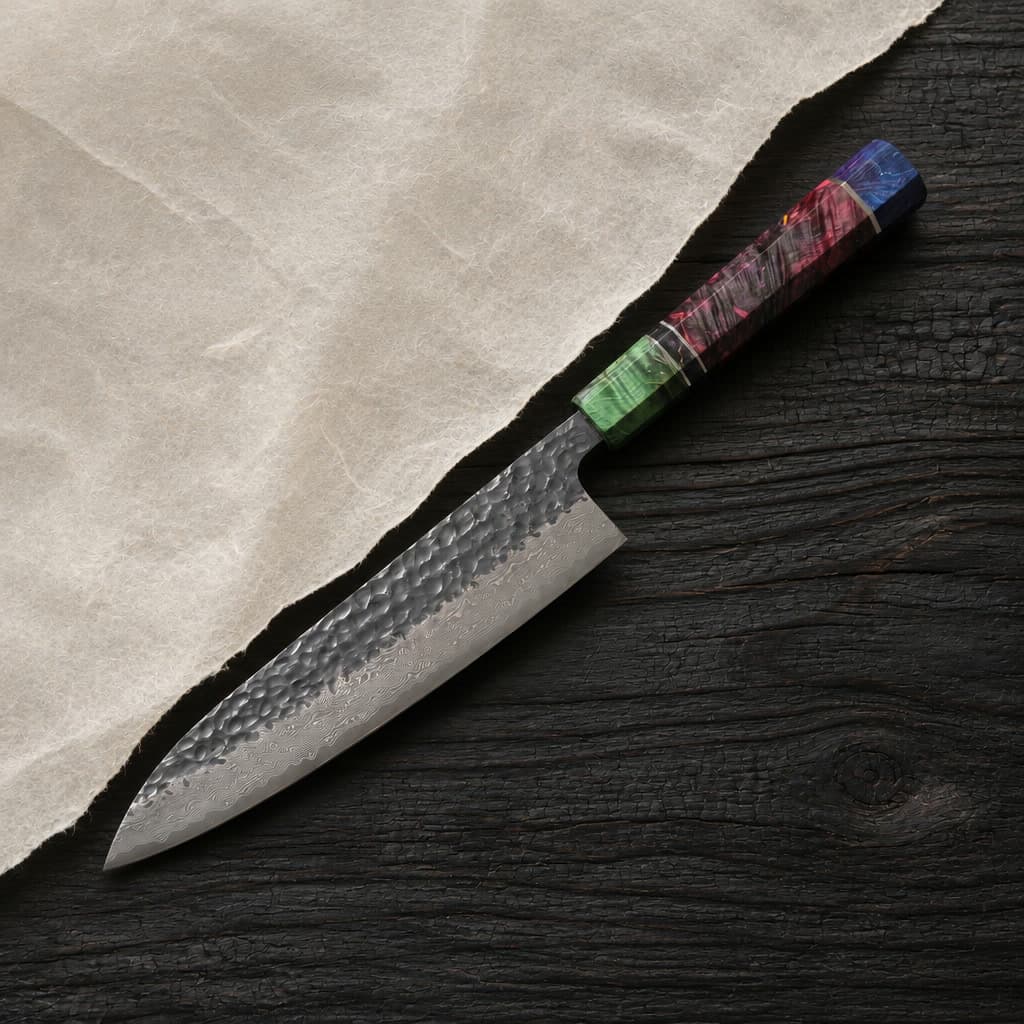
How does a gyuto differ from other chef knives?
A Gyuto and a Western chef’s knife fill largely the same role: each is meant to be a versatile, everyday kitchen knife. What sets them apart is how a given knife is shaped, built, balanced and sharpened. A Gyuto can feel lighter, thinner or more precise than certain Western chef’s knives, but that comes down to the individual model, not to every Japanese knife.
GYUTO OR WESTERN CHEF'S KNIFE: HOW DO THEY COMPARE?
The gap usually lies in blade geometry, weight, profile and steel rather than in the basic task the knife does. Many Western chef’s knives have a fairly hefty blade and are built for a mix of chopping and rocking. Gyuto knives may use thinner geometries and harder steels, though individual models differ widely.
FEATURE
GYUTO
WESTERN CHEF'S KNIFE
Main role
All-round kitchen prep
All-round kitchen prep
Blade profile
Usually more pointed, with a curved edge
Usually wider, with a marked curve
Weight
Can be fairly light, depending on the model
Usually heavier
Steel
A broad range of Japanese steels
A broad range of stainless and other steels
Edge geometry
Usually fairly fine
Usually a little sturdier
Cutting feel
Can lean towards precise cuts with little resistance
Usually suits a wider range of cutting techniques
Maintenance
Varies with steel and hardness
Varies with steel and construction
It pays to steer clear of a blunt “Japanese versus Western” comparison. A thick, heavy Gyuto can handle quite differently from a thin, light one, just as Western chef’s knives differ widely from brand to brand.
GYUTO OR SANTOKU: HOW DO THEY COMPARE?
A Japanese Gyuto knife usually gives you a longer blade and a more marked pointed tip than a santoku. That added reach helps when you prepare bigger ingredients or make long slicing cuts.
Santoku knives tend to be shorter and more compact, with a flatter cutting profile. They can be especially comfortable on a smaller chopping board, or when most of your prep relies on short chopping and slicing motions.
FEATURE
GYUTO
SANTOKU
Usual profile
Longer, with more curve
Shorter, mostly flatter
Tip
Marked pointed tip
Shorter, compact tip
Reach
Longer
Shorter
Board space
Works best with more room
Easy on smaller boards
Overall role
All-round chef knife
All-round kitchen knife
Precision work
Excellent tip control
Solid all-round control
Neither shape is automatically the better knife. The question that matters is which mix of length, profile, geometry and handling suits the way you cook.
If you want a single longer knife with extra reach and a pointed tip, a Gyuto can feel like an obvious match. If you prefer a compact blade with a shorter, flatter profile, a santoku may be the better pick.
Which gyuto size is right for you?
Choosing a Gyuto chef knife size comes down mostly to your workspace, what you cook and how much blade you feel at ease controlling. Length counts, but never in isolation: blade height, weight, balance, handle design and overall geometry can make two Gyuto of identical length feel nothing alike.
Many cooks find that 210 mm strikes a good balance between reach and manoeuvrability. Even so, no single size is “correct” for everyone. A small kitchen or compact chopping board may call for a 180 mm Gyuto, while cooks who often handle bigger ingredients may want the extra reach of a 240 mm blade or longer.
GYUTO SIZES COMPARED
GYUTO SIZE
APPROX. LENGTH
BEST USE
WORKSPACE
180 mm
7 in (18 cm)
Compact daily prep
Small chopping boards and kitchens
210 mm
8.25 in (21 cm)
All-round preparation
Suits most home kitchens
240 mm
9.5 in (24 cm)
Bigger ingredients and long slicing
Needs more board space
270 mm
10.6 in (27 cm)
High-volume or professional prep
Ideal with a large workspace
SHOULD YOU CHOOSE A 180 MM GYUTO?
A 180 mm Gyuto earns its place when worktop space is tight or when you like a more compact knife. It moves more easily around a small chopping board and can feel less unwieldy for quick prep jobs.
IS 210 MM A GOOD ALL-ROUND GYUTO SIZE?
A 210 mm Japanese Gyuto knife sits at a sensible midpoint between manoeuvrability and reach. It gives you enough blade for most daily prep without needing the space a far longer knife would take up.
This is why 210 mm is a frequent benchmark when people compare Gyuto sizes, though it should not be assumed to be the right pick for every cook.
WHEN IS A 240 MM GYUTO WORTH IT?
A 240 mm Gyuto adds cutting length for bigger ingredients and longer slicing strokes. It suits cooks in particular who have plenty of board space and feel at ease with a longer blade.
The trade-off is straightforward: a longer blade needs more room and more deliberate control.
WHO SHOULD CONSIDER A 270 MM GYUTO?
A 270 mm Gyuto is a far longer choice, better suited to cooks who often handle large ingredients or prep in bigger volumes. To use it comfortably, you need a chopping board and workspace that are large enough.
Before you go for a longer Gyuto, measure the usable length of your chopping board. The blade needs space to move without constantly striking the edges of the board or the equipment around it.
Which steels are gyuto knives made from?
A Gyuto knife’s steel shapes its edge retention, how it takes to sharpening, its corrosion resistance, its toughness and how much upkeep it needs. No one “Gyuto steel” exists: makers choose stainless, carbon or powder metallurgy steels according to how the knife is meant to perform.
STEEL CATEGORY
KEY TRAIT
MAINTENANCE
Stainless
Stronger corrosion resistance and simpler daily care
Lower
Carbon
Sharpens easily, with a lively cutting feel
Higher
Powder metallurgy
Strong wear resistance and long edge retention
Varies by model
For home cooks who want less upkeep, stainless steel is often the sensible option. It resists staining and corrosion better, so you can use it often without rushing to dry it after every single cut.
Many knife enthusiasts prize carbon steel for the way it sharpens and the feel of its cut. It does need more care, though, since moisture or acidic ingredients can cause discolouration or corrosion.
Powder metallurgy steels are designed for strong wear resistance and can hold an edge exceptionally well. How they sharpen and what care they need come down to the particular steel and its heat treatment, not just the category.
Hardness is another spec worth getting to grips with. Gyuto knives can carry fairly high HRC ratings, yet a higher number does not by itself make one knife superior to another. Heat treatment, blade geometry, edge thickness, grind and intended use all affect how a knife cuts.
As an example, the relevant HOSHIGANE Gyuto models combine a VG-10 core, 60 ±2 HRC hardness and 67-layer Damascus construction. These figures describe how those specific models are built and what they are made of; they do not define every Gyuto knife.
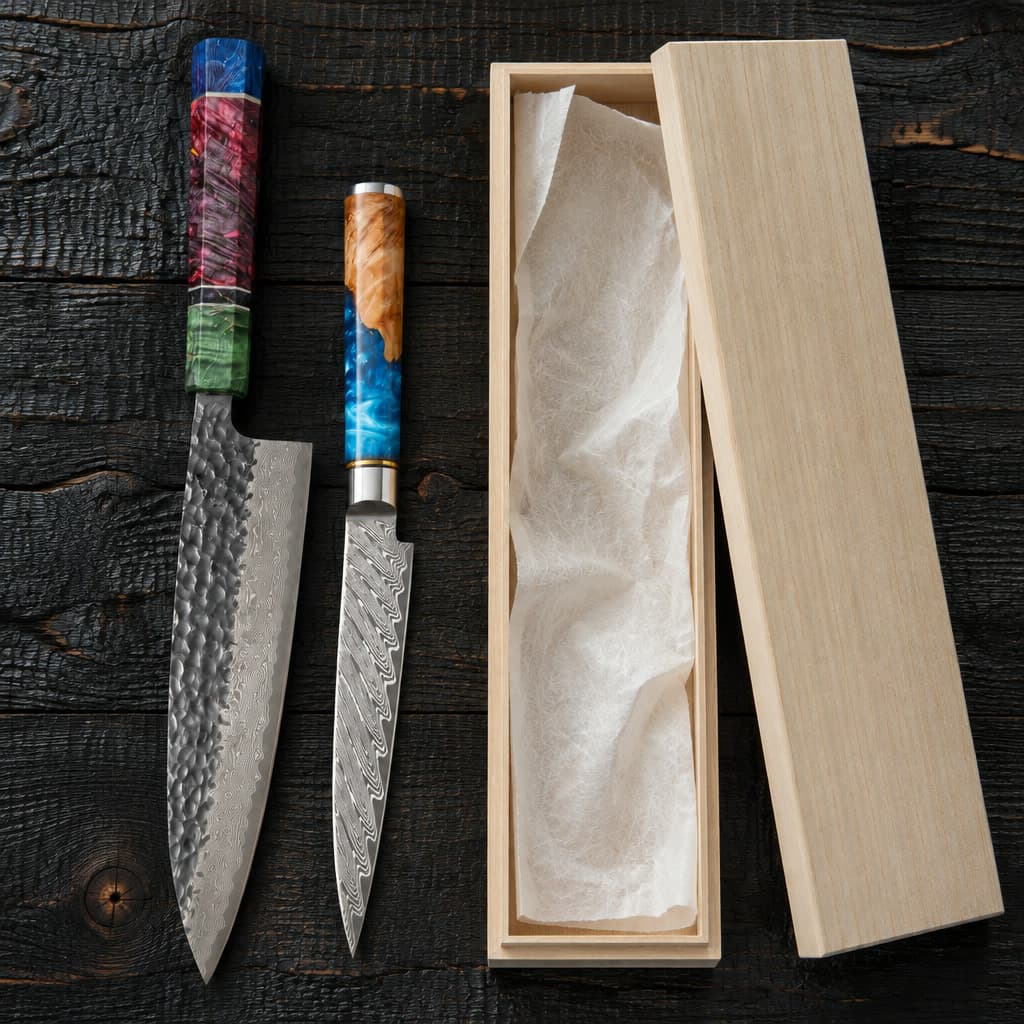
What do you need to know about gyuto blade geometry?
Blade geometry does much to shape how a Gyuto feels on the chopping board. Two knives made from similar steel can still cut very differently owing to variations in spine thickness, grind, edge thickness, blade height, profile and edge angle.
A thinner blade tends to pass through food with less resistance, whereas a thicker, sturdier geometry can add robustness for heavier daily prep. That is why picking a Gyuto purely on its steel type or HRC rating can overlook a key part of how the knife really cuts in practice.
When comparing Gyuto knives you may also see words like “laser” and “workhorse”. These are casual labels from the knife community, not standardised manufacturing categories. A laser usually means a very thin, light geometry made to cut with little resistance, while a workhorse typically refers to a thicker, heftier knife designed for durability and a more solid cutting feel.
Edge angle is one more spec to look at. Many Gyuto are sharpened at roughly 15–18° per side, though each maker may choose its own angle. HOSHIGANE product information, for instance, notes that the relevant knives are hand-honed at around 12–15°, depending on the product. No single edge angle therefore defines a Gyuto.
In the end, geometry should be weighed alongside steel, heat treatment, blade length, profile and the cutting technique you plan to use, not judged as a spec on its own.
How do you choose a japanese gyuto knife?
Picking a Japanese Gyuto knife gets simpler once you look past the steel name or the Damascus pattern. The best choice comes down to how you cook, how much room you have to work and how you like a knife to feel in your hand.
A sensible way to compare Gyuto knives is to work through these points in turn:
- Blade length: Pick a size that suits your chopping board and the ingredients you usually cut. A shorter blade can be easier to control, while a longer one gives you more reach for bigger ingredients and long slicing strokes.
- Cutting style: Think about whether you mainly chop, push-cut, slice or mix techniques. A knife’s profile and geometry can affect how naturally it fits the motion you prefer.
- Steel and maintenance: Stainless steel can make daily care simpler, whereas carbon and some high-performance steels may need more looking after.
- Grind and geometry: Look at thickness, edge geometry and overall blade build instead of assuming that every Gyuto cuts alike.
- Weight and balance: Some cooks like a light, nimble knife, while others prefer a blade with more heft and steadiness.
- Handle design: The shape, material and balance of the handle can affect comfort over longer prep sessions.
- Ingredients: Consider what you really cut. A Gyuto excels with vegetables, herbs, boneless meat and other everyday prep, but specialised knives may be a better choice for jobs involving bones or especially hard foods.
WHICH GYUTO FITS WHICH COOK?
USER
WHAT TO LOOK AT
Home cook
A manageable size, simple upkeep and versatile geometry
Professional chef
Blade length, edge retention, balance and comfort over long shifts
Culinary enthusiast
Steel, grind, profile and how it sharpens
Collector
Craftsmanship, build, finish, materials and the maker’s individual details
What matters is comparing the whole knife specification, not only its looks or its steel name. A striking Damascus finish may catch the eye, but blade geometry, balance, dimensions and upkeep have far more impact on day-to-day use.
How do you look after a gyuto chef knife?
Good care helps a Gyuto chef knife keep its edge, finish and cutting performance for years. Most Japanese kitchen knives do well with a few simple habits: wash by hand, dry straight away and cut only on a suitable surface.
DO
- Wash the knife by hand with water and a mild washing-up liquid.
- Dry it straight after washing, particularly if it is carbon or high-hardness steel.
- Cut on a suitable chopping board, such as wood or soft plastic.
- Keep the knife safe in a block, saya or other protective storage.
- Sharpen it properly once the edge starts to lose its bite.
AVOID
- Dishwashers, which subject the blade to heat, moisture and harsh detergents.
- Glass, stone or ceramic surfaces, which can harm the edge.
- Cutting through bone or frozen food, unless that particular knife has been made specifically for the job.
- Prying, twisting or sideways force, especially with thin-edged blades.
A harder, thinner Gyuto can cut superbly, but it also repays more careful handling. Regular cleaning, sensible storage and proper sharpening generally matter more to a knife’s long-term care than elaborate maintenance routines.
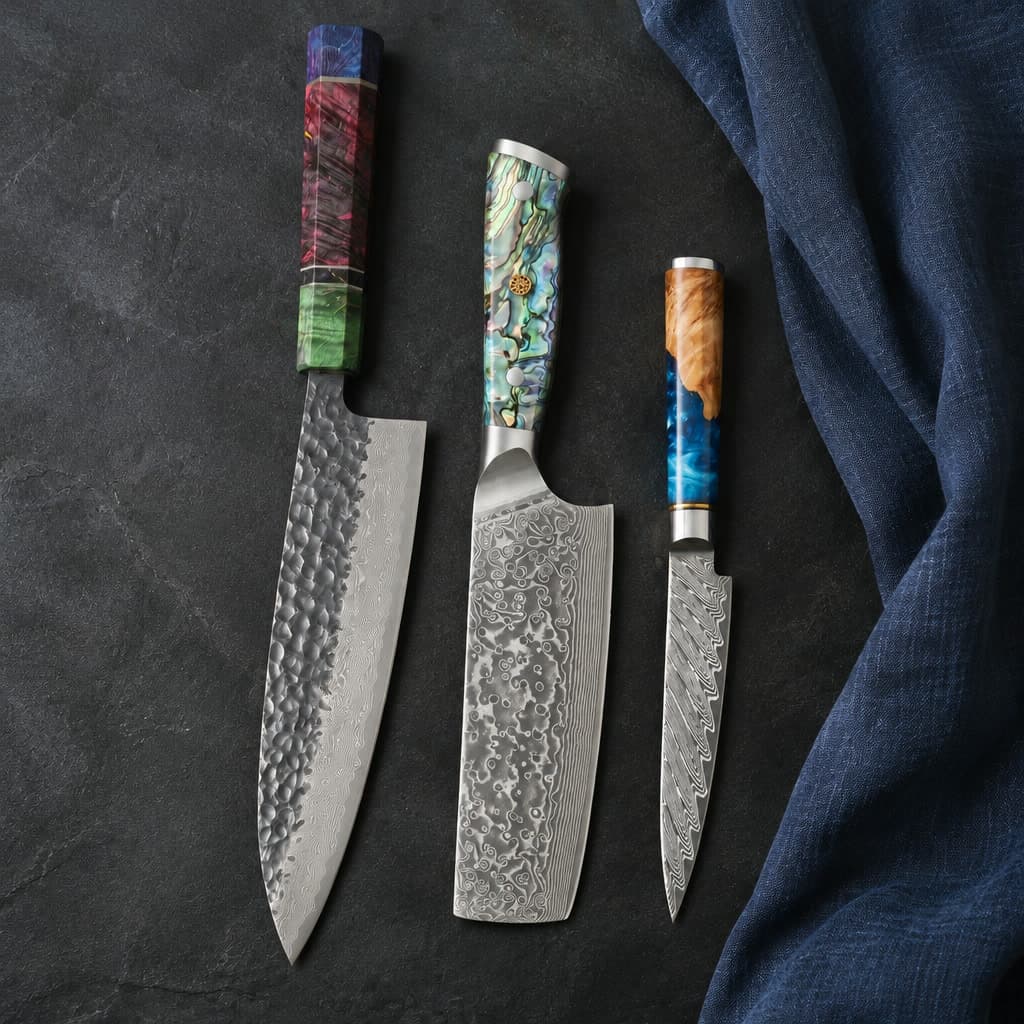
Which gyuto knives does Hoshigane offer?
HOSHIGANE has a dedicated Gyuto collection for cooks who want to compare Japanese chef knives across a range of constructions, blade lengths, finishes and handle designs. Instead of picking a knife purely on looks, compare the specifications that suit how you cook and how much upkeep you want.
In the HOSHIGANE Gyuto collection, you can look at details such as:
- Blade lengths for different workspaces and prep needs
- Steel build and core material
- Damascus layers and finish
- Handle design and how the knife balances
- Weight and blade specs
- Edge geometry, where the product page provides it
Models can vary a great deal, so rely on the specifications shown on each product page when you compare knives. As an example, the relevant HOSHIGANE models have a VG-10 core, 60 ±2 HRC hardness and 67-layer Damascus construction.
If you already know which blade length and kind of cutting feel you like, the collection helps you narrow down the choice without assuming that one Gyuto spec suits every cook.
Browse the [HOSHIGANE Gyuto collection] to compare the models on offer and the specifications of each.
Gyuto chef knives: frequently asked questions
WHAT DEFINES A GYUTO CHEF KNIFE?
A Gyuto chef knife is an all-purpose Japanese kitchen knife made for jobs like chopping, slicing and general food prep. Most have a pointed tip, a curved edge and a double-bevel design, though the exact geometry changes from maker to maker and model to model.
WHICH GYUTO SIZE SHOULD I BUY?
In most home kitchens, 180 mm, 210 mm and 240 mm are the sensible sizes to look at. A 180 mm Gyuto fits smaller workspaces, and 210 mm gives a versatile balance for daily prep. A 240 mm blade adds reach for bigger ingredients and longer slicing work.
IS A GYUTO A CHEF'S KNIFE?
A Gyuto fills much the same all-purpose role as a Western chef's knife, yet the two can differ in blade geometry, weight, profile, steel, hardness and edge traits. It is best seen as a Japanese category of chef knife, not as a carbon copy of a Western chef's knife.
CAN A GYUTO HANDLE MEAT AND VEGETABLES?
Yes. A Gyuto works well on vegetables, herbs, boneless meat, poultry and fish fillets, as well as for everyday slicing and chopping. Bones, frozen food and hard materials are usually best left to knives built for those jobs.
HOW DOES A GYUTO DIFFER FROM A SANTOKU?
A Gyuto is usually longer, with a more marked pointed tip and a curved profile, which gives it extra reach and versatility for slicing and varied cutting motions. A santoku tends to be shorter and more compact, with a flatter profile suited to cooks who like a controlled, compact way of cutting. Exact shapes differ by manufacturer.