
Knife guides
Gyuto or Santoku: Which Knife Should You Choose?
28 September 2026
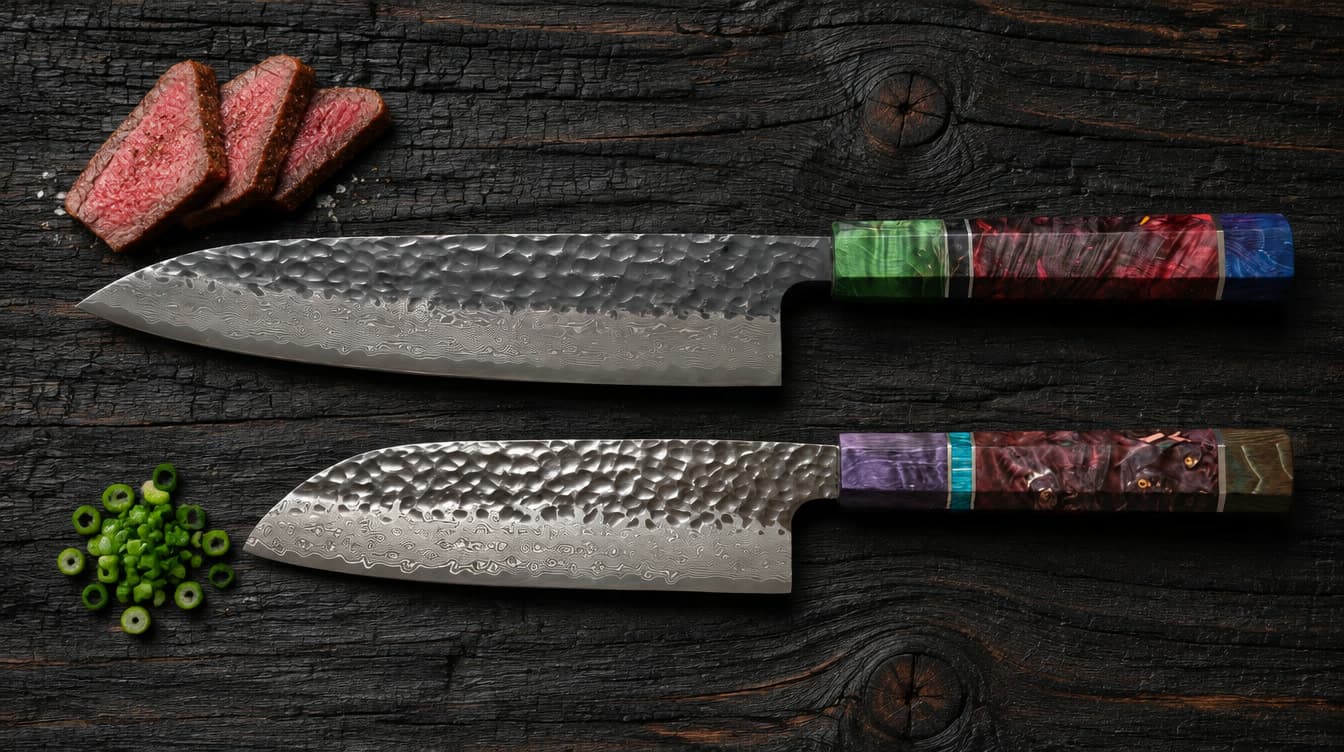
The Gyuto and the Santoku are the best-loved Japanese-style chef knives, and either can be the one knife you pick up every day. Most home cooks begin with an 8 inch Gyuto or a 7 inch Santoku. What separates them is not quality but shape, length and how you prefer to cut.
Quick answer: Go for the Gyuto if you rock the blade and want a single long knife for everything, big cuts of meat included. Go for the Santoku if you chop straight down and want a shorter knife that stays easy to control.
Gyuto and santoku side by side
GYUTO
SANTOKU
Typical length
8 in (ours range from 6 to 9 in, 23 cm)
7 in (ours range from 5 to 7.5 in, 19 cm)
Profile
Long edge with a soft curve, pointed tip
Flatter edge, spine sloping down to the tip
Cutting motion
Rocking cuts and long slicing strokes
Straight chop, up and down
Typical weight
Around 7 oz (200 g) at 8 in (20 cm)
Around 6 oz (170 g) at 7 in (18 cm)
Best for
Meat, fish, big vegetables, herbs
Daily vegetables, quick chopping
Choose it if
You rock a Western chef knife already
You want your first Japanese knife compact
What is a gyuto knife?
The Gyuto is Japan's take on the Western chef knife. It is long, most often 8 inches, and its edge sweeps gently upward to a fine point. Thanks to that curve you can rock the blade, keeping the tip close to the board as the heel rises and drops. Its length lets you cut through a roast or a fish fillet in a single long stroke rather than sawing back and forth.
What is a santoku knife?
The Santoku is shorter, most often 7 inches, with a flatter edge and a spine that slopes down to join it at the tip. Its name is commonly translated as "three virtues": meat, fish and vegetables. With more of the flat edge touching the board, it lends itself to a straight up-and-down chop and a forward push cut, which many cooks find easier to keep under control.
The way each one cuts
This is where you will notice the biggest difference.
- Gyuto: rocking motions and long slicing strokes. The curved edge pivots from heel to tip, ideal for mincing herbs and garlic and for slicing big cuts.
- Santoku: straight chops and push cuts. Its flat edge meets the board squarely, so thin slices come apart cleanly and a steady rhythm comes naturally.
Neither technique is the right one. If a Western chef knife is what you learned on, the Gyuto will feel familiar straight away. If you tend to chop straight down, the Santoku will.
Which one wins at what?
VEGETABLES
Both do an excellent job. The flat edge of the Santoku is built for quick, even chopping of onions, carrots, cucumbers and cabbage leaves. The extra length of the Gyuto comes in handy for big produce, like cutting a whole cabbage or a melon in half.
MEAT AND FISH
Here the Gyuto comes out ahead. A longer blade glides through a roast, a chicken breast or a salmon fillet in fewer strokes, and its pointed tip makes trimming easier. A Santoku copes well with everyday meat and fish; big cuts simply need more strokes. Neither is meant for bones or frozen food.
HERBS AND GARLIC
Thanks to its curve, the Gyuto rocks through herbs and garlic in no time. A Santoku minces with short up-and-down chops, which works nicely once you find the rhythm.
Size, board and storage
An 8 inch Gyuto needs a chopping board long enough for the whole stroke. A 7 inch Santoku is more at home on a smaller board and in a cramped drawer, and the shorter blade often feels more natural in smaller hands. Our range also covers 5 inch Santoku knives and Gyuto knives up to 9 inches. To learn more about length, read How to Choose the Right Knife Size.
The same steel, the same care
At HOSHIGANE, both shapes share one construction: a VG-10 steel core wrapped in 67 layers of Damascus cladding, hardened to 60 ±2 HRC and given a hand-finished edge of 12 to 15 degrees per side. That means you are choosing a shape and a length, not a level of quality. Most of our Santoku series are also made as a Gyuto with the same handle, so you can add the other shape later and have a matching pair.
The care is identical as well: hand wash, dry immediately, cut on wood or plastic and sharpen on a whetstone. How to Care for a Japanese Knife explains the one-minute routine.
So which one is for you?
CHOOSE THE GYUTO IF
- You already own a Western chef knife and enjoy rocking it.
- You regularly cook big cuts of meat or fish, or large vegetables.
- You want a single long knife for nearly every task.
CHOOSE THE SANTOKU IF
- You like a straight up-and-down chop.
- You mostly prep vegetables, and your board or drawer is fairly small.
- You want a shorter, lighter knife that feels in control from the very first cut.
Still undecided? Begin with the shape that suits the way you cut now. Lots of cooks eventually own both, a Gyuto for the big tasks and a Santoku for fast weeknight prep, and several of our knife duos combine the two in one style. Browse all Gyuto knives or all Santoku knives.
SHOP THE GUIDE
SANTOKU KNIVES
Free delivery Australia-wide · returns within 30 days